Beyond My Karate Lineage – A Journey of Learning, Research, and Friendship

I train as a member of a few dōjō. However, there are also dōjō that I have visited as a visitor, researcher, and guest. In these cases, my stays were relatively short, so one cannot speak of a teacher-student relationship. Naturally, I would never claim that such a relationship exists.

However, I can proudly say that, even after my visits, I make a considerable effort to maintain friendly contact with the masters of the respective dōjō.

My dōjō visits actually only began this year [2026]. I was fortunate enough to visit the Kōmeikan Dōjō of Miyagi Tōru sensei, where I was able to train for three hours. Before my visit, I naturally obtained permission from Beppu. My aim was to learn more about the Kōmeikan’s Sanseirū and to investigate the connection between Miyagi Takashi and Kyoda Jūhatsu in greater detail. But more on that later.

I was also fortunate enough to participate in a training session at the TOGKF Honbu Dōjō. I was in the fortunate position of having all three Shihan present, and they offered me advice. However, this dōjō visit also lasted only two hours—a time that I thoroughly enjoyed. I had already arranged my visit during the European Gasshuku in Halle/Germany, and I was very pleased to have the opportunity to train there.

In addition to my own brief training sessions, I was also fortunate enough to observe training sessions as a guest. On these occasions, I sat quietly at the edge of the training area and watched the training. I had this opportunity at the dōjō of Sakumoto Tsuguo Sensei (Ryū’ei-ryū) and at the Shitō-ryū dōjō of Mabuni Ken’yū, the grandson of Mabuni Kenwa, the founder of Shitō-ryū.

During my visit, I was particularly fortunate to witness a training session with Shimizu Kiyō, who was being coached by Japanese national kata coach Furukawa Tetsuya and Mabuni Ken’yū himself. After the main training sessions, Mabuni Ken’yū was also kind enough to answer a few of our questions about Shitō-ryū. This interview will be featured in a future article.

My actual training, however, takes place elsewhere.
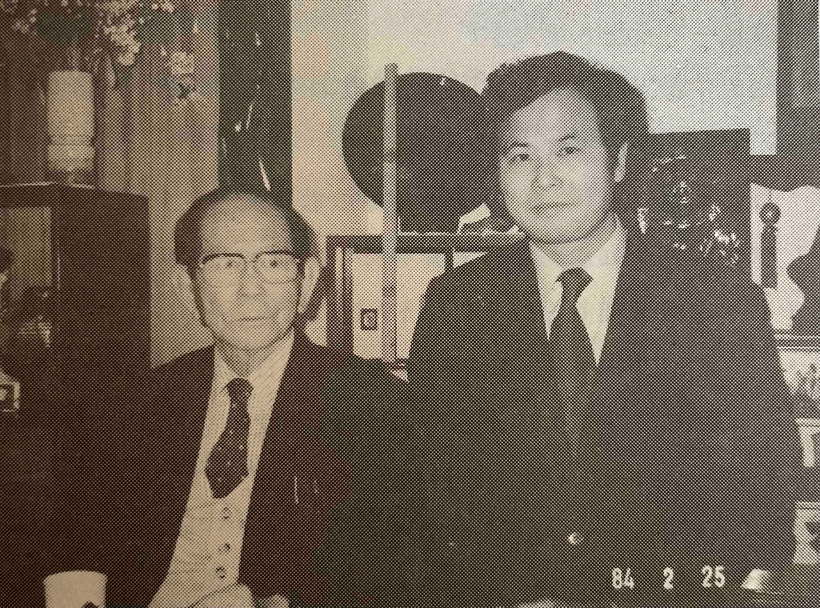
Iraha Chōkō and Hokama Tetsuhiro

I recently had the good fortune to write an article about Iraha Chōkō (1901–1986), which was subsequently published (Gekkan Hiden 2026/10). In this article, I also addressed the connection between Iraha Chōkō and Hokama Tetsuhiro. Unfortunately, due to space limitations, I was unable to discuss the subject in full. I would therefore like to elaborate on it here.

Iraha Chōkō and Hokama Tetsuhiro

Hokama Sensei met Iraha Sensei at the latter’s home on 25. February 1984, where he was also able to see the “Kyoda Jūhatsu Sensei Karate-dō Kun.” A photograph of it appears in Hokama’s book Okinawa Karate-dō no Ayumi. Hokama did not, however, visit Iraha Sensei alone; he was apparently introduced to him by Iraha’s nephew, Chōketsu.

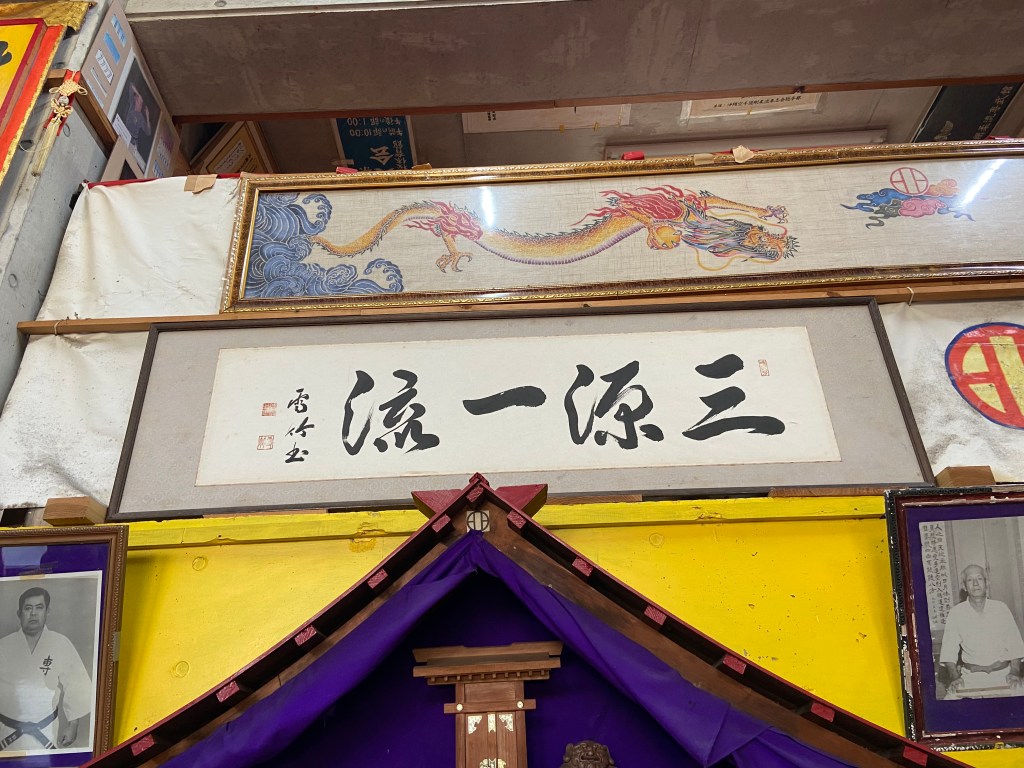
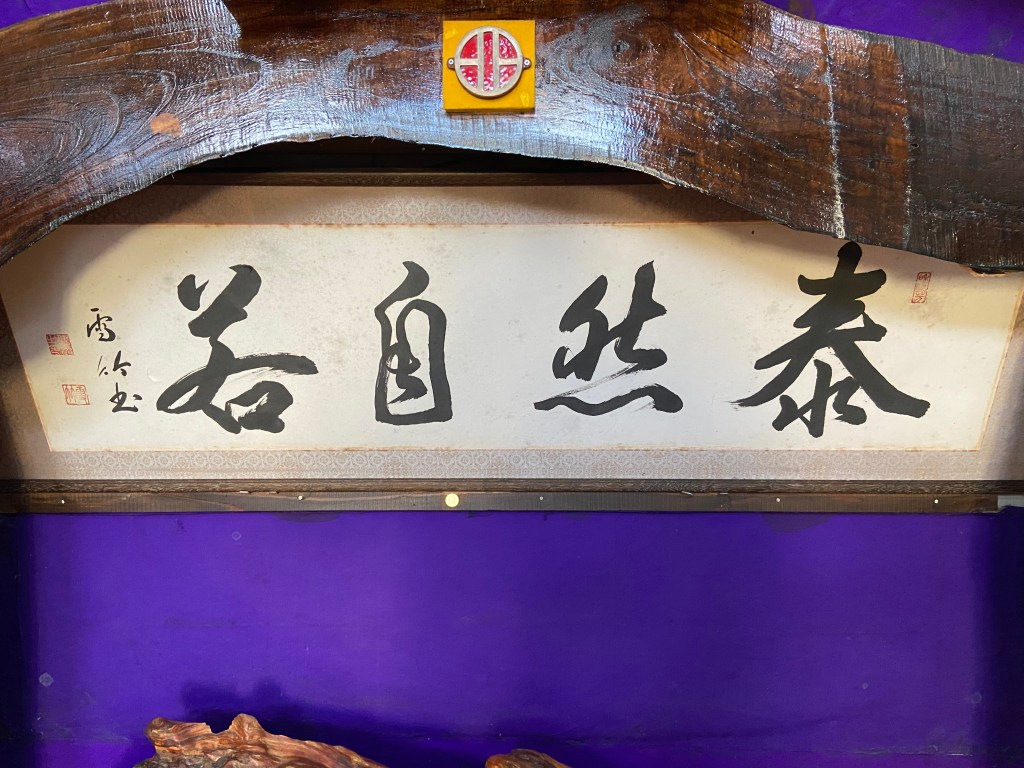
Hokama also attended Iraha’s calligraphy exhibition in February 1985. A pamphlet containing all of Iraha Chōkō’s works was also produced for this event. However, the calligraphy “Sangen Ichiryū” is absent from this pamphlet, although the original is still preserved today in Hokama Sensei’s dōjō. By contrast, the calligraphy “Taizen Jijaku” is included in the pamphlet and likewise remains preserved in the dōjō.

It can therefore be assumed that “Sangen Ichiryū” was one of Iraha Chōkō’s final works and was created during the last year of his life.

Sangen Ichiryū 三源一流

The calligraphy “Sangen Ichiryū” (三源一流) can be understood as three origins converging into a single stream. Whether Iraha had Tō’on-ryū in mind when creating this calligraphy requires further investigation.

As you are undoubtedly aware, Tō’on-ryū incorporates elements of Naha-te (Sanchin, Seisan, Sanseirū, and Pecchūrin), Shuri-te (Jion), and White Crane (Nepai). In a sense, these represent three distinct origins that converge within Tō’on-ryū to form a single style.

Taizen Jijaku

The calligraphy “Taizen Jijaku” (泰然自若) represents the ability to remain calm and composed, even in difficult situations. It describes a state of mind in which a person maintains inner peace and self-control, regardless of the challenges they face.