I am pleased to announce that I, Yannick Schultze, have been appointed International Coordinator by the Tō’on-ryū Karate-dō Honbu Dōjō (Tō’on-kai).
My primary role is to serve as a bridge between karate practitioners worldwide and the Tō’on-ryū Honbu Dōjō, working closely with the Honbu to ensure that those interested in studying Tō’on-ryū can arrange their training in Beppu as smoothly as possible.
My native language is German, and I also speak English and basic Japanese. Furthermore, my wife, who is a native Japanese speaker, provides additional support with specific inquiries to the Honbu.
Having earned the deep trust of the Tō’on-ryū Sōke, Ikeda Jūshū Shihan, I am confident in my ability to fulfill the responsibilities of this position.
For many years, I have been researching the history of Okinawan karate. As a dedicated student of Tō’on-ryū Karate-dō, I have accepted this position out of a strong desire to support karate practitioners around the world.
Moving forward, I am committed to fulfilling the expectations of the Tō’on-ryū community and honoring the trust that has been placed in me.
In April next year, I am booked to teach a Tō’on-ryū Karate-dō seminar in Hamburg, Germany’s second-largest city.
This seminar has been in preparation since May, shortly after I opened my first dōjō in Drochtersen. It all began when Birger Heime, a Gōjū-ryū karateka (Yuishinkan), asked me whether I would be interested in teaching a seminar in Hamburg next year.
I told him that I first needed to ask for permission, which I did shortly afterwards. Ikeda Sensei, the fourth Sōke of Tō’on-ryū, gave me the green light to teach the seminar, but under the condition that there would be a strict no-recording policy—which I fully agree with.
The main topics of the seminar will be the two kata Sanchin and Sanseirū, both of which are shared by Tō’on-ryū and Gōjū-ryū. The Seisan of Tō’on-ryū does not originate from Higaonna Kanryō Sensei, and for this reason there is less scope for a direct comparison between the versions of the two systems. Although there are similarities, Sanseirū was also specifically requested as one of the main topics of the seminar.
As soon as more information becomes available, Birger and I will share it immediately.
Until then, save the date: April 3, 2027 — Hamburg, Germany.
A German kobudōka asked me a question a few days ago regarding the hojoundō for nunchaku. In doing so, he was trying to answer several questions that had occupied him for quite some time.
Although the nunchaku is one of my favorite weapons in Matayoshi Kobudō, legally practicing with it in Germany is impossible; only substitute training methods are permitted. In Germany, for example, I practice with a thick rope and use it to train the corresponding movements.
My first training session with the nunchaku (using a substitute training method) took place in Belgium. Under Jhonny Bernaschewice sensei, I learned both the hojoundō and the kata. This was around 2009. In the following years, I also trained intensively with the nunchaku under Yogi Josei sensei. After we had worked through the kata for the bō (five kata / later six kata), sai (three kata), and tunkwā (one kata)—yes, Gakiya and Yogi taught only a single tunkwā kata—Yogi would ask me each time which weapon I wanted to continue with next. My answer was always the same: nunchaku. As a result, I also trained intensively with the nunchaku under Yogi. At the time, this training always took place between Yogi’s main training days, Thursday and Saturday.
But back to Jhonny sensei. In addition to training with the various weapons, we had countless conversations in which we talked about Okinawa, the Kōdōkan, and his time under Gakiya. On several occasions, our conversations also turned to how he had first learned nunchaku techniques at the Kōdōkan. Contrary to what one might perhaps assume, his first experience with them was not under Gakiya sensei. Instead, he initially learned the kata under Ogido Hiroko sensei, together with Kobayashi sensei. Some time later, Murayama sensei came to the Kōdōkan and taught the two of them further refinements. It was ultimately Murayama Seitetsu sensei who taught Jhonny the hojoundō for nunchaku.
I recently read on Facebook that Matayoshi sensei taught only eight techniques as hojoundō for nunchaku. I must strongly disagree with this claim. At the Kōdōkan, the nunchaku hojoundō consisted of ten techniques. The question, of course, would be whether Matayoshi sensei actually taught all of these techniques to foreign students as well.
There is even a photograph from 1985 showing Matayoshi Shinpō sensei (1921–1997) in front of the list of hojoundō for nunchaku—approximately twelve years before his death. To claim that two techniques were added only after Matayoshi sensei’s death is therefore incorrect. This error should be corrected accordingly.
And yes: neither Gakiya sensei nor Yogi sensei ever taught the hojoundō for nunchaku. An acknowledged expert in the nunchaku hojoundō, however, is Murayama Seitetsu sensei, a student of Itokazu Seikō sensei who also trained under Matayoshi Shinpō sensei.
From the beginning of the 1980s onward, there were also significant differences between the curriculum of the Kōdōkan and that of the Zen Okinawa Kobudō Renmei.
I train as a member of a few dōjō. However, there are also dōjō that I have visited as a visitor, researcher, and guest. In these cases, my stays were relatively short, so one cannot speak of a teacher-student relationship. Naturally, I would never claim that such a relationship exists.
However, I can proudly say that, even after my visits, I make a considerable effort to maintain friendly contact with the masters of the respective dōjō.
My dōjō visits actually only began this year [2026]. I was fortunate enough to visit the Kōmeikan Dōjō of Miyagi Tōru sensei, where I was able to train for three hours. Before my visit, I naturally obtained permission from Beppu. My aim was to learn more about the Kōmeikan’s Sanseirū and to investigate the connection between Miyagi Takashi and Kyoda Jūhatsu in greater detail. But more on that later.
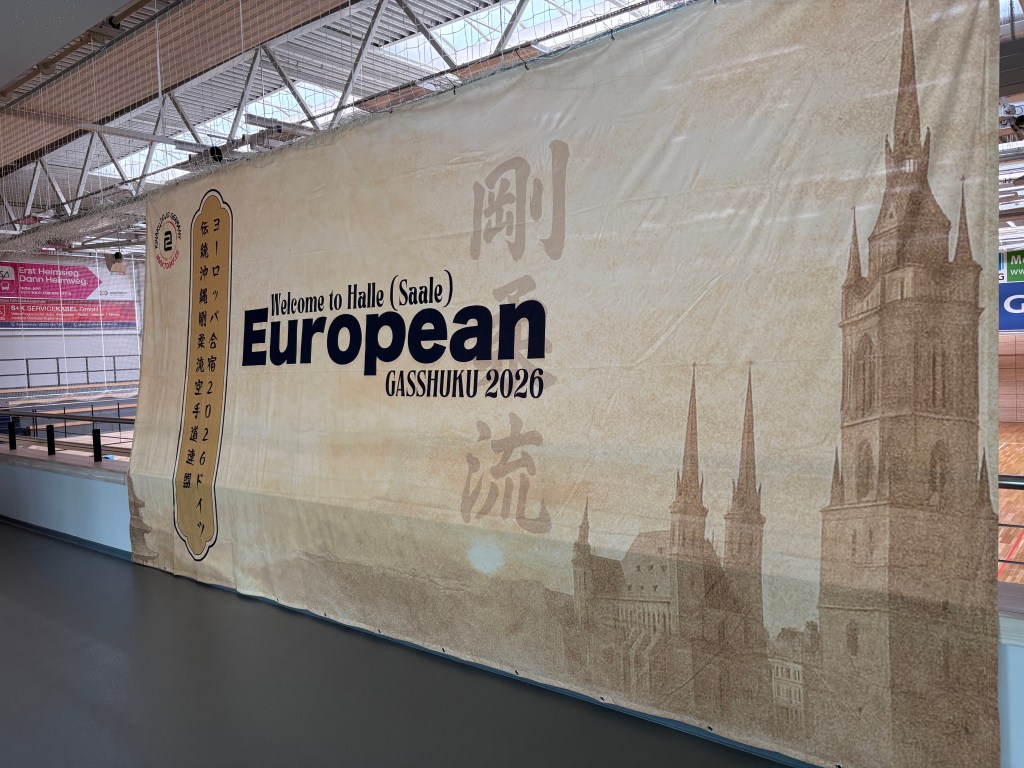
I was also fortunate enough to participate in a training session at the TOGKF Honbu Dōjō. I was in the fortunate position of having all three Shihan present, and they offered me advice. However, this dōjō visit also lasted only two hours—a time that I thoroughly enjoyed. I had already arranged my visit during the European Gasshuku in Halle/Germany, and I was very pleased to have the opportunity to train there.
In addition to my own brief training sessions, I was also fortunate enough to observe training sessions as a guest. On these occasions, I sat quietly at the edge of the training area and watched the training. I had this opportunity at the dōjō of Sakumoto Tsuguo Sensei (Ryū’ei-ryū) and at the Shitō-ryū dōjō of Mabuni Ken’yū, the grandson of Mabuni Kenwa, the founder of Shitō-ryū.
During my visit, I was particularly fortunate to witness a training session with Shimizu Kiyō, who was being coached by Japanese national kata coach Furukawa Tetsuya and Mabuni Ken’yū himself. After the main training sessions, Mabuni Ken’yū was also kind enough to answer a few of our questions about Shitō-ryū. This interview will be featured in a future article.
My actual training, however, takes place elsewhere.
I recently had the good fortune to write an article about Iraha Chōkō (1901–1986), which was subsequently published (Gekkan Hiden 2026/10). In this article, I also addressed the connection between Iraha Chōkō and Hokama Tetsuhiro. Unfortunately, due to space limitations, I was unable to discuss the subject in full. I would therefore like to elaborate on it here.
Iraha Chōkō and Hokama Tetsuhiro
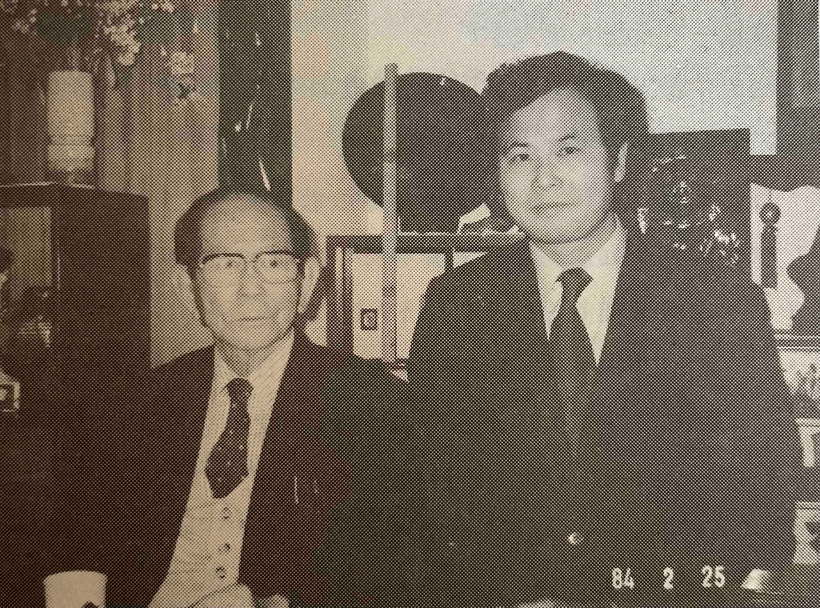
Hokama Sensei met Iraha Sensei at the latter’s home on 25. February 1984, where he was also able to see the “Kyoda Jūhatsu Sensei Karate-dō Kun.” A photograph of it appears in Hokama’s book Okinawa Karate-dō no Ayumi. Hokama did not, however, visit Iraha Sensei alone; he was apparently introduced to him by Iraha’s nephew, Chōketsu.
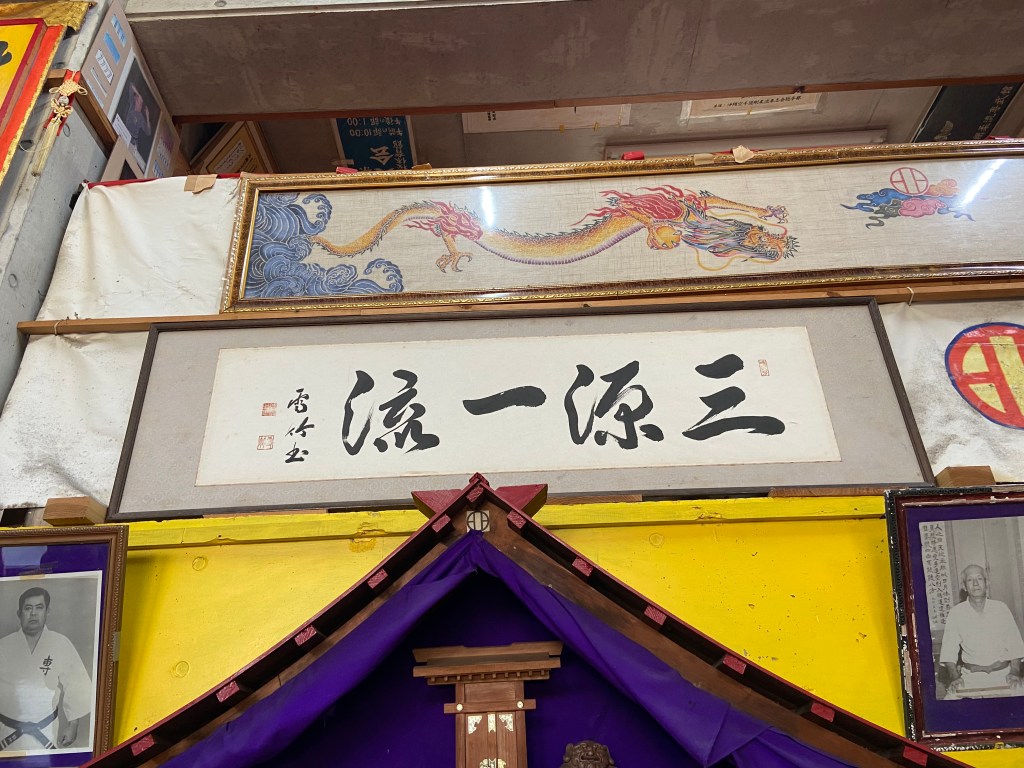
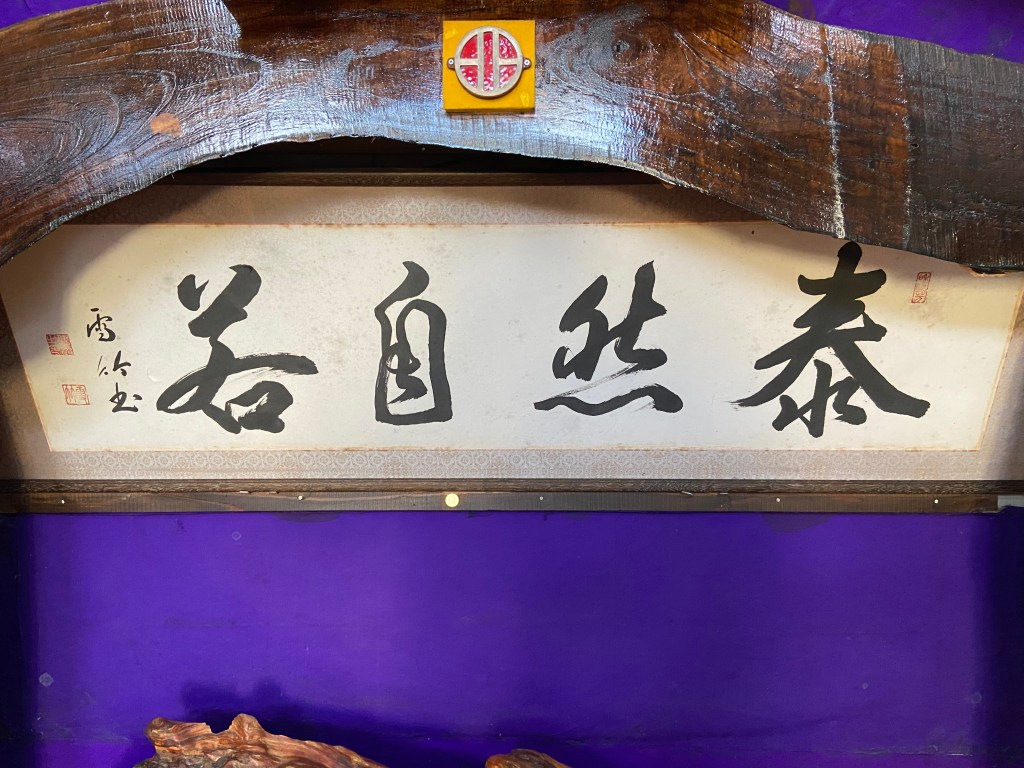
Hokama also attended Iraha’s calligraphy exhibition in February 1985. A pamphlet containing all of Iraha Chōkō’s works was also produced for this event. However, the calligraphy “Sangen Ichiryū” is absent from this pamphlet, although the original is still preserved today in Hokama Sensei’s dōjō. By contrast, the calligraphy “Taizen Jijaku” is included in the pamphlet and likewise remains preserved in the dōjō.
It can therefore be assumed that “Sangen Ichiryū” was one of Iraha Chōkō’s final works and was created during the last year of his life.
Sangen Ichiryū 三源一流
The calligraphy “Sangen Ichiryū” (三源一流) can be understood as three origins converging into a single stream. Whether Iraha had Tō’on-ryū in mind when creating this calligraphy requires further investigation.
As you are undoubtedly aware, Tō’on-ryū incorporates elements of Naha-te (Sanchin, Seisan, Sanseirū, and Pecchūrin), Shuri-te (Jion), and White Crane (Nepai). In a sense, these represent three distinct origins that converge within Tō’on-ryū to form a single style.
Taizen Jijaku
The calligraphy “Taizen Jijaku” (泰然自若) represents the ability to remain calm and composed, even in difficult situations. It describes a state of mind in which a person maintains inner peace and self-control, regardless of the challenges they face.
During my time in Okinawa, I naturally also took the opportunity to conduct historical research on Tō’on-ryū Karate-dō and Kyoda Jūhatsu sensei. This included discussions with experts who are very knowledgeable about Okinawan history and who entrusted me with some valuable information. Iraha Chōkō sensei was once again a topic of particular interest. My research on him is still at a very early stage, and I hope to learn much more about him in the future.
Okinawa Prefectural Library
Of course, I also had the opportunity to take part in training sessions that focused on karate closely resembling that of Kyoda Jūhatsu. I will write a little more about this over the next few days.
A scene from Karate Kid. (From the September 1984 issue of the monthly magazine Screen)
[Film] “Karate Kid” Becomes a Sensational Hit in the United States
The Late Miyagi Chōjun Served as the Model
Robert Visits Okinawa to Conduct Research for the Second Film
“I want to make the second film a success as well.” Robert, who visited Okinawa to conduct research for the screenplay of Karate Kid.
The karate film Karate Kid, whose central character was modeled on an Okinawan karate practitioner, has become a sensational hit in the United States. Within just one month of its release, the number of moviegoers exceeded ten million. Newspapers including the Chicago Sun-Times acclaimed it as “the best film of the year,” and it has also received high praise from critics.
The film centers on the emotional bond that develops through karate between an elderly second-generation Okinawan and a young boy, while throughout the story the “spirit of karate” is brought strongly to the forefront.
A release date in Japan has yet to be determined. Those involved have expressed growing interest in the film, saying, “It will make the name of Okinawan karate known throughout the world.”
The film is set in Los Angeles. The story concerns Miyagi, an elderly American-born, second-generation Okinawan and a master of karate (modeled on the late Miyagi Chōjun, founder of Gōjū-ryū), who teaches karate to a boy being tormented by a group of bullies. Through the rigorous training, Miyagi and the boy gradually develop a deep emotional bond. Eventually, the boy surpasses the group of bullies both mentally and physically, and in the final scene defeats their leader. In a sense, it might be described as a karate version of Rocky.
The film began screening at one thousand theaters across the United States in late June of this year. It quickly became a major hit, attracting ten million moviegoers to date and generating approximately 1.2 billion yen in box-office revenue.
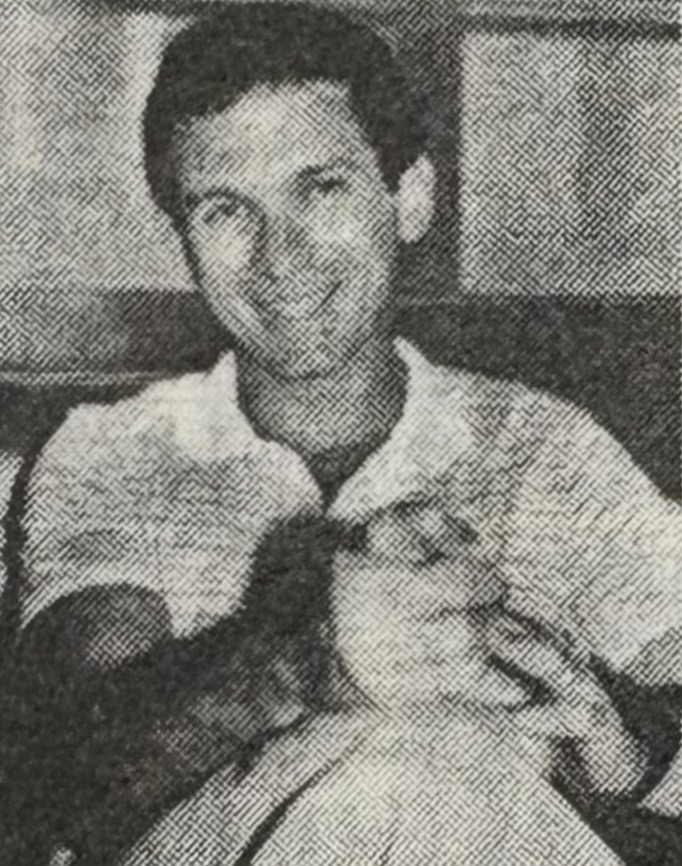
Robert Mark Kamen (36), who wrote the original screenplay for the film, recently visited Okinawa to conduct research for the second film. Kamen, who has twenty years of experience in karate, studied Gōjū-ryū in New York. Because of this connection, he said that he naturally envisioned the late Miyagi, a great pioneer of karate, as the model for the main character.
“What I sought to capture in the film was something of the spirit, purity, and profound depth of karate. It is completely different from ordinary action-oriented karate. When I came to Okinawa for the first time, I was deeply impressed to find that traditional karate had been preserved here.”
During his stay, he energetically conducted interviews with leading masters of Okinawan karate, regardless of style. Every karate practitioner he met was determined to preserve and foster traditional karate—karate as budō.
Kamen said, “This was in complete accord with my own philosophy of karate, and I was deeply moved. After listening to what they had to say, the image I have for the second film has also developed considerably,” expressing confidence in the forthcoming sequel.
The film will include scenes in which the elderly man and the boy visit Okinawa and encounter authentic karate in its homeland. Regarding the possibility of filming on location in Okinawa, Kamen said, “I hope that will happen.”
The director is John G. Avildsen, who made Rocky a hit.
Source:
Okinawa Times, August 4, 1984, p. 7.
Afterword:
I also had the good fortune to interview Robert Mark Kamen. The first part of the interview has already been published (Link), while the second part will appear on August 14, 2026.
This short newspaper article was published following Kamen’s visit to Okinawa and clearly states that his trip was undertaken as a research visit for the second Karate Kid film.
The article incorrectly describes Mr. Miyagi as having been born in the United States to Okinawan immigrant parents. This aspect of his background was, however, revised in the second film. We also know today that Karate Kid II was ultimately not filmed on Okinawa. Although filming on location in Okinawa was apparently being considered at this stage, the Okinawan scenes were instead filmed in Hawaii.
During my trip to Okinawa, a report began circulating announcing the death of Gakiya Yoshiaki Sensei. I also received private messages informing me of the same.
I had already heard about Gakiya Sensei’s alleged passing some time ago. I had the good fortune to train under him in 2008, 2009, and 2010, although I would never describe myself as one of his students. I first heard about his supposed death in 2025, and I asked several Okinawan sensei about it. I received different answers. Among other things, I was told that he was said to have passed away even before Yogi Josei Sensei.
This reminded me of a personal experience involving my grandparents that I would like to share here. At the time, my grandparents lived on a farm. The mailbox where the newspaper was delivered was more than a kilometer away from the house. My task in the mornings was first to collect the eggs from the chicken coop and then make my way to the mailbox to pick up the newspaper.
When I returned, the first thing my grandparents would look at was the obituary section of the newspaper, and they would talk about people they knew. Both of them were already over 70 years old at the time. Most of those who had passed away were acquaintances rather than close friends. When it came to close friends, they did not have to learn such sad news from the newspaper; they would be informed by telephone by relatives or people close to them.
I remember a conversation with my instructor, Jhonny Bernaschewice, in November 2024, during which we spoke about his last meeting with Gakiya Yoshiaki Sensei. In 2014, Jhonny travelled with a group of students from Naha to Nago to visit Gakiya Sensei and receive a training session at his dōjō. After returning to Europe, Jhonny received an email asking him to refrain from visiting Gakiya Sensei again.
Each of these visits was very difficult for Gakiya Sensei. On the one hand, he was of course happy to see his students again, but on the other hand, it was very painful for him that he was no longer able to train himself—something he had dearly loved to do and that had brought him great joy. Those who trained under Gakiya Sensei will understand the passion he had for training.
In 2024, I asked Yogi Josei how Gakiya Sensei was doing, and he replied that he did not know, as he too was no longer in contact with him. Gakiya Sensei had therefore largely withdrawn from public life.
At this point, I do not know exactly where the alleged report of his death originated, but it came from Okinawa. During my trip, international practitioners also heard this alleged news of his death, and it was quickly shared on social media without first being verified.
Just as my grandparents used to look through the obituary notices in the daily newspaper to learn about the deaths of acquaintances, there are similar ways of obtaining such information in Okinawa. Examples include the obituary notice for Yogi Josei Sensei or the recently published sad announcement of the passing of Takushi Seiki Sensei.
I pray for Gakiya Sensei’s well-being and, at the same time, would like to urge everyone not to accept and spread everything they read on social media without careful consideration—especially when it concerns something as serious as the death of another human being.
The Karate-dō Kun of Kyoda Jūhatsu became known through the work of Hokama Tetsuhiro, who visited Iraha Chōkō sensei, a student of Kyoda Jūhatsu and the renowned calligrapher who wrote the Karate-dō Kun. Hokama sensei also visited an exhibition where Iraha displayed various examples of his calligraphy from throughout his career.
Kyoda Jūhatsu sensei Karate-dō kun
The Karate-dō Kun consists of five precepts. However, there are actually five additional precepts, bringing the total to ten. These additional five precepts have remained unknown until now, but I will soon present all ten precepts in their entirety.
The TOGKF (Traditional Okinawan Goju-Ryu Karate-Do Federation) is still a relatively young organization, yet the roots of the association itself already go back to 1979, and today it is represented very strongly on an international level. I personally have never been, nor am I currently, a member of the organization. Nevertheless, I have many friends within the TOGKF, and this is exactly how the connection I would like to write about came into existence.
Photo taken by me
It all actually began because I had already been friends with one of the members on Facebook for quite some time. As fate would have it, both of us happened to be in Naha, Okinawa, in January 2024, and we were even staying at the same hotel. After my very first night struggling with jet lag, we met early in the morning at the hotel and briefly spoke with one another. I had just returned from shopping — in Japan many supermarkets are open 24 hours a day — while my friend Thomas Krekel was already on his way to work.
During the trip we met many more times, and one morning we eventually arranged to have breakfast together. In the end, there were five of us sitting together, including another Gōjū-ryū karateka. During breakfast, Thomas told us that it would be a great pleasure for him if we could write a seminar report about the upcoming TOGKF Hawaii Gasshuku — a gasshuku intended to commemorate Miyagi Chōjun’s journey to Hawaii 90 years earlier.
I immediately agreed, though with one condition: instead of writing only one report, I wanted to write two — one report about the TOGKF gasshuku itself, and another about Miyagi Chōjun’s actual journey to Hawaii in 1934.
The gasshuku eventually took place in April 2024, and the report was published in January 2025 — almost exactly 90 years after Miyagi Chōjun had left Hawaii again in 1935.
The report was received very positively within the TOGKF, and shortly afterward I was invited to the 3rd European Gasshuku of the TOGKF. I was asked whether I would be willing to give a historical lecture about Miyagi Chōjun and Gōjū-ryū during the event — a request I was naturally very happy to accept immediately.
In the meantime, I also had the opportunity to watch a demonstration by TOGKF members during the 49th Nihon Kobudō Enbu Taikai. This event takes place every year at the famous Budōkan in Tōkyō, and every two years TOGKF members are also invited to perform there.
My lecture at the gasshuku brought me a great deal of positive feedback, something that made me very happy despite my nervousness. At the same time, it was also my very first live lecture, and naturally it left me with a strong desire to continue giving presentations of this kind in the future.
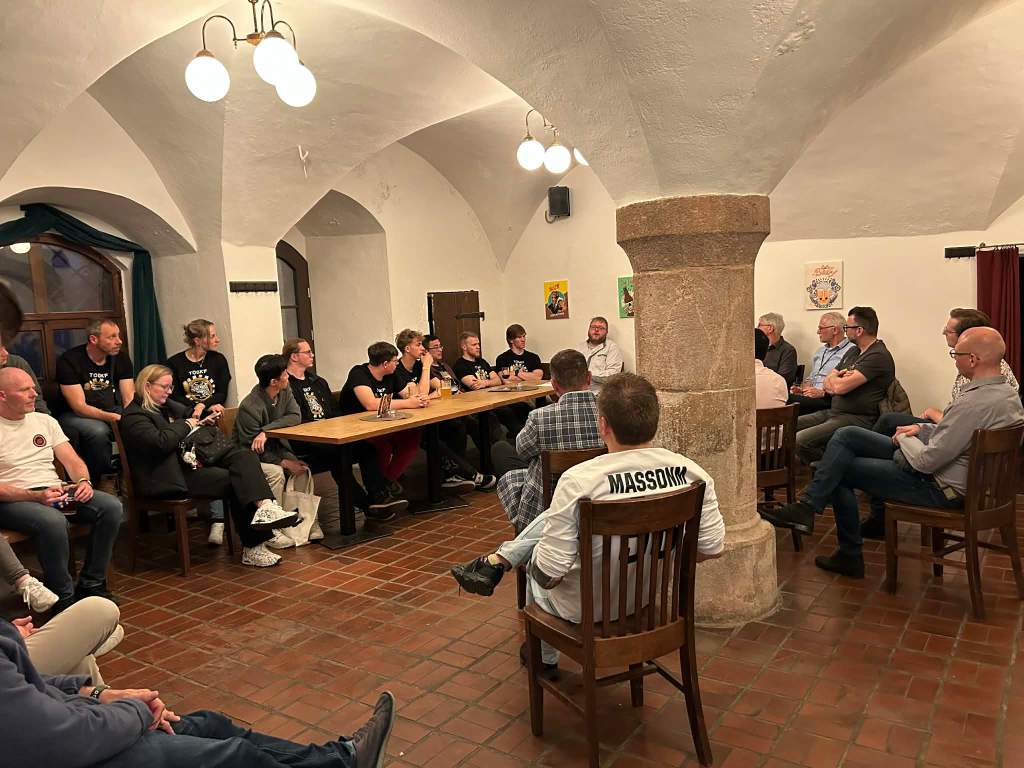
The lecture in front of over 30 karateka (Photo courtesy of Martin Osborn)
As already mentioned, I am not a Gōjū-ryū karateka — my lineage is Tō’on-ryū, a style which also has historical connections with Higaonna Morio sensei. Higaonna sensei once visited Beppu in order to see Tō’on-ryū for himself, and he later wrote a short report about it which was published in Gekkan Karate-dō. In addition, when the 4th Sōke of Tō’on-ryū first began practicing karate, his earliest steps were taken at Higaonna sensei’s Yoyogi Dōjō in Tōkyō.
During a shared dinner in Beppu on February 14th, I told Ikeda sensei that I would soon be giving a lecture — news that made both him and the other participants very happy.
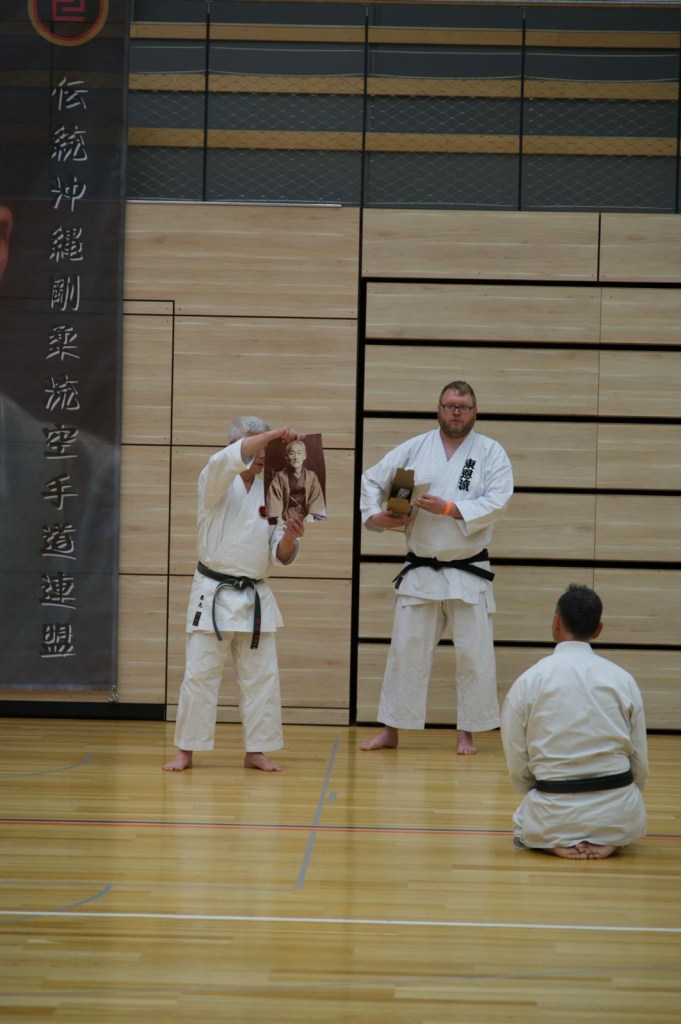
At the gasshuku in Halle, I also presented Kuramoto sensei with a photographic gift showing Higaonna Kanryō sensei — the patriarch of both Gōjū-ryū and Tō’on-ryū — in extraordinary detail and clarity. I sincerely hope that the image will find a beautiful place within the dōjō in the future.
Kuramoto sensei showing the photo to the 140 participants (Photo courtesy of Paul Stutzinger)
The image itself was extracted from a group photograph that remains in the private possession of the Kyoda family. It was Kyoda Jūhatsu sensei himself who preserved this image from the flames of war. Naturally, I hope that the property and legacy of the Kyoda family will continue to be respected and protected — although unfortunately that hope was quickly diminished. But envy is perhaps as old as sin itself.
Therefore, I kindly ask people to keep the following in mind: if anyone happens to encounter an extremely detailed version of this photograph — one where even the cords of the suit can be seen in absolute clarity, perhaps even colorized — then the image was obtained illegally. And that is simply a fact.
But I am drifting away from the main story.
The gasshuku itself was a truly wonderful event, organized in an exceptionally professional manner and leaving no wishes or questions unanswered. During the seminar, I had the pleasure of meeting many new friends. I was able to hear fascinating stories about how Gōjū-ryū karate spread throughout countries such as Belgium, South Africa, Moldova, and many other parts of the world.
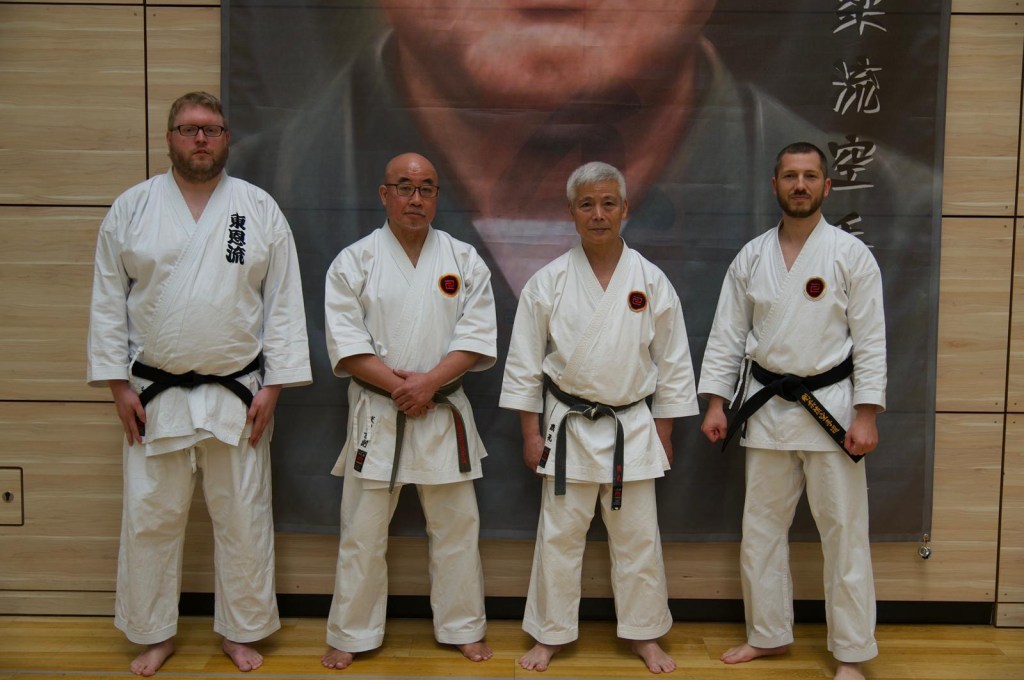
From left: Me, Yonesato sensei, Kuramoto sensei and Paul Stutzinger (Photo courtesy of Paul Stutzinger)
I especially connected very quickly with the Polish community. One reason for this was my teacher, Jhonny Bernaschewice, who was very well known in Poland, gave countless seminars there, and continues to be deeply respected.
I am already looking forward to maintaining many of these new friendships and acquaintances, and I sincerely hope to see many of them again very soon.
If anyone is interested in organizing a lecture together with me in the future, please feel free to contact me personally. I work independently of any organization and maintain friendships across many different Gōjū-ryū associations.