

Some time ago, I translated the obituary of Kyoda Jūhatsu sensei, written by his senior Okinawan student, Iraha Chōkō sensei. In this text, Iraha reflects upon his former teacher in a tone marked by both respect and warmth.
Within the obituary, Iraha recounts a meeting in Beppu. I would therefore like to present his words to the reader directly.
„After the training, we would take a moment to rest, and eventually, my teacher would offer me a cup. As I listened to his voice again after such a long time, with each cup we shared, a wave of nostalgia washed over me. Conversations of the old days resurfaced, and the lonely hometown transformed into the legendary realm of Wuling (FN 1). I was deeply moved by my teacher’s profound affection, feeling an overwhelming sense of gratitude. My wish for his health and well-being only grew stronger.“
According to Kyoda’s grandson, Iraha visited Beppu on numerous occasions and remained vividly remembered by him. Iraha sensei also supported him in his study of kanji.
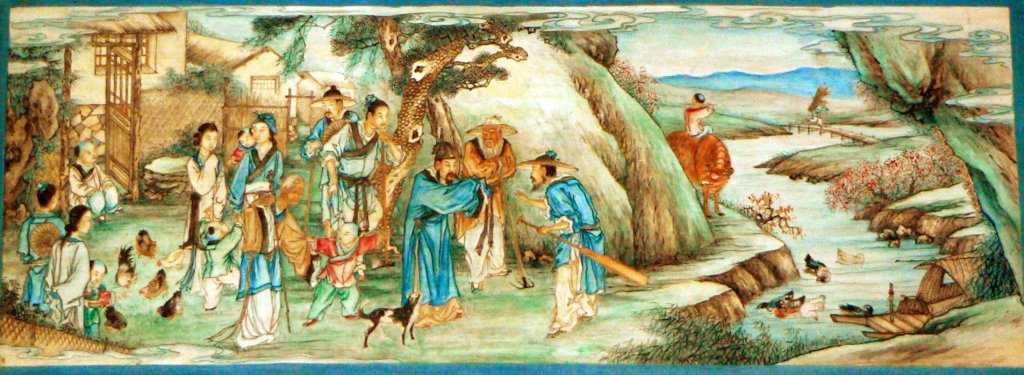
In the text, Iraha makes reference to Wuling—an allusion to a utopian realm whose origins lie in the classical Chinese fable of the Peach Blossom Spring.
This passage is of particular interest, as Beppu has come to hold a similar significance for me: a place in which I can devote myself entirely to training, communicate exclusively in Japanese, and, to a certain extent, withdraw from the distractions of the outside world.
It is my sincere hope to return to Beppu in the near future and to continue my training there.
FN 1 – Iraha referred to the story of the Peach Blossom Spring (Táohuāyuán Jì, 桃花源记), a famous Chinese fable written by Táo Yuānmíng 陶淵明 (365-427) during the Eastern Jin dynasty (317-420). It tells of a fisherman from Wuling who accidentally discovers a hidden utopia while following a stream lined with blooming peach trees. Inside this secluded valley, the people live in harmony with nature, free from the troubles of the outside world and unaware of political upheavals. For an English translation of the text, see Birch, Cyril (1965): Peach Blossom Spring, pp. 167–168, in Anthology of Chinese Literature – From Early Times to the Fourteenth Century.

