During my time in Okinawa, I naturally also took the opportunity to conduct historical research on Tō’on-ryū Karate-dō and Kyoda Jūhatsu sensei. This included discussions with experts who are very knowledgeable about Okinawan history and who entrusted me with some valuable information. Iraha Chōkō sensei was once again a topic of particular interest. My research on him is still at a very early stage, and I hope to learn much more about him in the future.
Okinawa Prefectural Library
Of course, I also had the opportunity to take part in training sessions that focused on karate closely resembling that of Kyoda Jūhatsu. I will write a little more about this over the next few days.
A scene from Karate Kid. (From the September 1984 issue of the monthly magazine Screen)
[Film] “Karate Kid” Becomes a Sensational Hit in the United States
The Late Miyagi Chōjun Served as the Model
Robert Visits Okinawa to Conduct Research for the Second Film
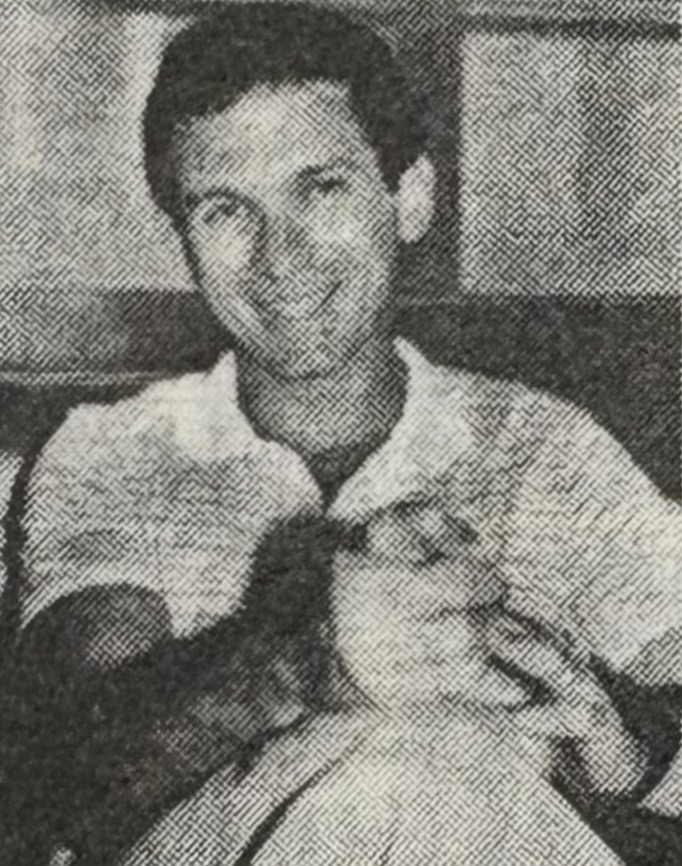
“I want to make the second film a success as well.” Robert, who visited Okinawa to conduct research for the screenplay of Karate Kid.
The karate film Karate Kid, whose central character was modeled on an Okinawan karate practitioner, has become a sensational hit in the United States. Within just one month of its release, the number of moviegoers exceeded ten million. Newspapers including the Chicago Sun-Times acclaimed it as “the best film of the year,” and it has also received high praise from critics.
The film centers on the emotional bond that develops through karate between an elderly second-generation Okinawan and a young boy, while throughout the story the “spirit of karate” is brought strongly to the forefront.
A release date in Japan has yet to be determined. Those involved have expressed growing interest in the film, saying, “It will make the name of Okinawan karate known throughout the world.”
The film is set in Los Angeles. The story concerns Miyagi, an elderly American-born, second-generation Okinawan and a master of karate (modeled on the late Miyagi Chōjun, founder of Gōjū-ryū), who teaches karate to a boy being tormented by a group of bullies. Through the rigorous training, Miyagi and the boy gradually develop a deep emotional bond. Eventually, the boy surpasses the group of bullies both mentally and physically, and in the final scene defeats their leader. In a sense, it might be described as a karate version of Rocky.
The film began screening at one thousand theaters across the United States in late June of this year. It quickly became a major hit, attracting ten million moviegoers to date and generating approximately 1.2 billion yen in box-office revenue.
Robert Mark Kamen (36), who wrote the original screenplay for the film, recently visited Okinawa to conduct research for the second film. Kamen, who has twenty years of experience in karate, studied Gōjū-ryū in New York. Because of this connection, he said that he naturally envisioned the late Miyagi, a great pioneer of karate, as the model for the main character.
“What I sought to capture in the film was something of the spirit, purity, and profound depth of karate. It is completely different from ordinary action-oriented karate. When I came to Okinawa for the first time, I was deeply impressed to find that traditional karate had been preserved here.”
During his stay, he energetically conducted interviews with leading masters of Okinawan karate, regardless of style. Every karate practitioner he met was determined to preserve and foster traditional karate—karate as budō.
Kamen said, “This was in complete accord with my own philosophy of karate, and I was deeply moved. After listening to what they had to say, the image I have for the second film has also developed considerably,” expressing confidence in the forthcoming sequel.
The film will include scenes in which the elderly man and the boy visit Okinawa and encounter authentic karate in its homeland. Regarding the possibility of filming on location in Okinawa, Kamen said, “I hope that will happen.”
The director is John G. Avildsen, who made Rocky a hit.
Source:
Okinawa Times, August 4, 1984, p. 7.
Afterword:
I also had the good fortune to interview Robert Mark Kamen. The first part of the interview has already been published (Link), while the second part will appear on August 14, 2026.
This short newspaper article was published following Kamen’s visit to Okinawa and clearly states that his trip was undertaken as a research visit for the second Karate Kid film.
The article incorrectly describes Mr. Miyagi as having been born in the United States to Okinawan immigrant parents. This aspect of his background was, however, revised in the second film. We also know today that Karate Kid II was ultimately not filmed on Okinawa. Although filming on location in Okinawa was apparently being considered at this stage, the Okinawan scenes were instead filmed in Hawaii.
During my trip to Okinawa, a report began circulating announcing the death of Gakiya Yoshiaki Sensei. I also received private messages informing me of the same.
I had already heard about Gakiya Sensei’s alleged passing some time ago. I had the good fortune to train under him in 2008, 2009, and 2010, although I would never describe myself as one of his students. I first heard about his supposed death in 2025, and I asked several Okinawan sensei about it. I received different answers. Among other things, I was told that he was said to have passed away even before Yogi Josei Sensei.
This reminded me of a personal experience involving my grandparents that I would like to share here. At the time, my grandparents lived on a farm. The mailbox where the newspaper was delivered was more than a kilometer away from the house. My task in the mornings was first to collect the eggs from the chicken coop and then make my way to the mailbox to pick up the newspaper.
When I returned, the first thing my grandparents would look at was the obituary section of the newspaper, and they would talk about people they knew. Both of them were already over 70 years old at the time. Most of those who had passed away were acquaintances rather than close friends. When it came to close friends, they did not have to learn such sad news from the newspaper; they would be informed by telephone by relatives or people close to them.
I remember a conversation with my instructor, Jhonny Bernaschewice, in November 2024, during which we spoke about his last meeting with Gakiya Yoshiaki Sensei. In 2014, Jhonny travelled with a group of students from Naha to Nago to visit Gakiya Sensei and receive a training session at his dōjō. After returning to Europe, Jhonny received an email asking him to refrain from visiting Gakiya Sensei again.
Each of these visits was very difficult for Gakiya Sensei. On the one hand, he was of course happy to see his students again, but on the other hand, it was very painful for him that he was no longer able to train himself—something he had dearly loved to do and that had brought him great joy. Those who trained under Gakiya Sensei will understand the passion he had for training.
In 2024, I asked Yogi Josei how Gakiya Sensei was doing, and he replied that he did not know, as he too was no longer in contact with him. Gakiya Sensei had therefore largely withdrawn from public life.
At this point, I do not know exactly where the alleged report of his death originated, but it came from Okinawa. During my trip, international practitioners also heard this alleged news of his death, and it was quickly shared on social media without first being verified.
Just as my grandparents used to look through the obituary notices in the daily newspaper to learn about the deaths of acquaintances, there are similar ways of obtaining such information in Okinawa. Examples include the obituary notice for Yogi Josei Sensei or the recently published sad announcement of the passing of Takushi Seiki Sensei.
I pray for Gakiya Sensei’s well-being and, at the same time, would like to urge everyone not to accept and spread everything they read on social media without careful consideration—especially when it concerns something as serious as the death of another human being.