Gabu Seikei (1)

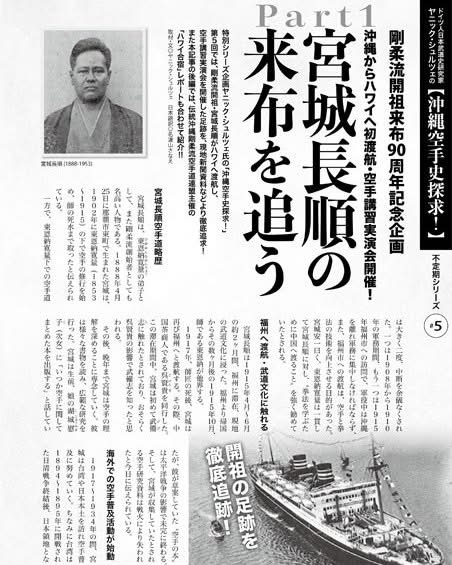
Gabu Seikei is a relatively unknown karateka, but he wasn’t just a karateka, he was also one of the first soldiers from the Prefecture of Okinawa. Together with Yabu Kentsū, Hanashiro Chōmo, and seven other Okinawans, Gabu joined the NCO School in Chiba Prefecture, becoming a soldier as well (Yabu, 1932a).

During my review of the original 1961 text,
February 25, 2025.

However, he has largely been forgotten in karate circles. His name, for instance, has often been mistaken as a typographical error for Yabu’s name, as shown in the following two examples—both of which are copies of a text by Tokuda Antei (Yōshū, 1961).

„Karate was first initiated by Hanashiro Chōmo sensei and Yabu Kentsū sensei, along with around 28 enthusiastic students, at the site of the former Shuri Tōnokura National School (now within the premises of the Okinawa Bank), where we began practicing fundamentals such as Naihanchi.“ (Hokama, 1984).

„Karate was first initiated by Hanashiro and Yabu (with ‘Ga’ noted as a mistaken character for ‘Ya’), along with around twenty enthusiastic students, at the site of the former Shuri Tōnokura National School (now within the premises of the Okinawa Bank), where we began practicing fundamentals techniques such as Naihanchi.“ (Kinjō, 2011)

Hokama Tetsuhiro, in preparation for his first book, conducted extensive research and interviewed numerous masters of karate. Kinjō Hiroshi, a former student at the Okinawa Middle School and a direct student of Hanashiro Chōmo prior to World War II, was also well-connected within the Okinawan martial arts community.

It appears that Gabu’s name had already faded from public recognition even before the war. According to the recollections of Yabu Kentsū, Gabu served in the 13th Company (Yabu, 1932b) and also participated in the First Sino-Japanese War (1894–1895), including the Battle of Weihaiwei. (Ryūkyū Kyōiku, 1896).

However, Gabu is believed to have passed away sometime before 1932. Yabu notes that five former attendees of the Non-Commissioned Officers (NCO) School held biannual meetings (in spring and autumn), and Gabu’s name is not among those listed. (Yabu, 1932b).

Unfortunately, it remains unknown from which master Gabu Seikei may have learned karate. At this point, I will refrain from making any speculations.

One final note: Tokuda Antei (徳田安貞, 1884–1979) cannot be the son of Tokuda Anbun (徳田安文, 1886–1945), as I recently read elsewhere.

Reflections on the Role of a Literary Critic in the Field of Okinawan Karate History

From time to time, new ideas take shape in my mind, only to be set aside again after brief reflection. One such idea was to write well-founded reviews of publications related to the history of martial arts. However, the central conflict lies in my own attitude: I cannot—and do not wish to—gloss over the truth. My aim is to offer honest assessments, even if they may occasionally be perceived as uncomfortable.

There is a well-known phenomenon in public discourse: during international football tournaments, millions of “national coaches” suddenly emerge—people who otherwise show little interest in the sport but express their opinions with great confidence. A similar accusation could perhaps be made about me. However, I have a broad base of sources at my disposal; I have read many of the relevant works myself, and others are in my personal library and can be reviewed at short notice.

What strikes me is the increasingly frequent use of terms such as “well-researched,” “no source left out,” or “extensive literature review.” These expressions suggest a thorough academic engagement which, upon closer inspection, often proves unsubstantiated. It raises the question of whether all relevant sources were truly identified and correctly understood.

Should I decide to pursue the writing of reviews more regularly, it would likely not be without friction. Authors might feel personally attacked by critical comments, and readers, too, could view my open approach with disapproval. Honest criticism is often praised in theory, but in practice, its consequences are not always welcomed.

A comparison from everyday practice: in the field of karate, it is not uncommon for videos of kata performances to be critically discussed on social media. In many cases, this is even encouraged by the performers themselves, who, by sharing such recordings, actively seek feedback—both positive and critical. In this context, a conscious engagement with content is sometimes explicitly desired.

In the world of book publishing, however, a comparable level of openness is still rare. Critical reviews—especially negative ones—appear to be unwelcome. Rather than a nuanced examination of content and methodology, there is often a prevailing desire for praise and superlatives, which do not always correspond to the actual quality of the work.

Why I Wear a White Belt – and How Many Kata I Have Really Learned

Recently, I was asked two questions: First, why I always wear a white belt, and second, how many kata I have already learned.

To Question (1):

I began learning Okinawa/Matayoshi Kobudô under Jhonny Bernaschewice in 2007. Around 2001/2002, Jhonny decided to remove his black belt and wear only a white belt from then on. On one hand, it was meant to reflect his status – the desire to continue learning – and on the other hand, … .

Since I had the opportunity to fly to Okinawa with him, it felt natural for me to also wear a white belt. It is worth mentioning that I received my Shodan only a few months after my first trip to Okinawa – but I continued to wear the white belt.

Currently, I also train in a karate style, Tô’on-ryû Karatedô, which traces back to Kyoda Jûhatsu Sensei. My decision is to learn this style completely, without deviations or compromises, and to focus entirely on it. This means: I do not have a Dan in Tô’on-ryû – so I naturally continue to wear a white belt.

I have also had the opportunity to train several times at the Kôdôkan, where I wore a white belt as well. On one hand, I am unknown to the people there, and on the other hand, by wearing the white belt, I express my willingness to come as a student and learn. My decision was warmly received, and they thanked me for it. After a few minutes, there was a remark that my level was above that of a Shodan.

So, I come to Okinawa/Beppu to learn – not to showcase my black belt, which I do not yet have in this style.

To Question (2):

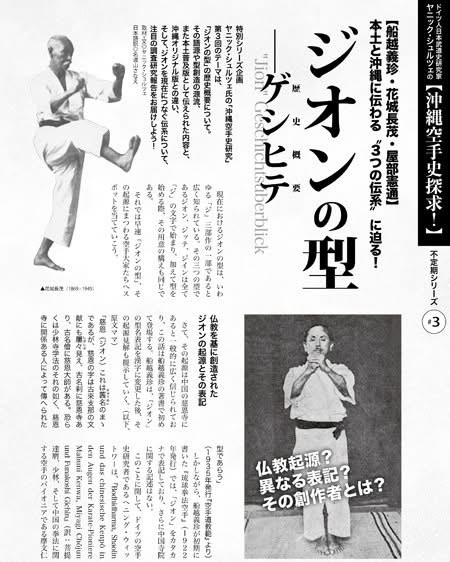
In Tô’on-ryû, I have learned four kata so far: Sanchin, Kan’yû no Sesan, Sanseru, and Yabu no Jion. The last time, I briefly saw Pecchûrin and Nepai.

But what does „learning“ actually imply? I know the sequences of the kata and have learned some Bunkai elements – but by no means all of them. Moreover, I am still far from being able to perform these kata even close to perfectly. The word „Kanpeki 完璧“ plays a crucial role in Tô’on-ryû training. It means that one can perform a kata flawlessly and has learned and understood all its elements. I am, of course, still very far from that.

Since I have only trained in Beppu three times, I would never claim to have fully learned the kata. This obviously requires years of training and a deep understanding.

Kyoda Sensei took about ten years to learn all of Higaonna Sensei’s kata – and he continued to train rigorously afterward, with the goal of Kanpeki.

So… I have superficially learned four kata and am still working hard to perfect them.

Talking About the Bubishi in the latest Podcast

In my latest podcast, Michael Calandra asked me if there were any solo forms (kata) depicted in pictures in the Bubishi. My answer was no, but I explained that they appear as text descriptions—specifically, Nepai is mentioned (written in the Bubishi as 弐拾捌 ).

Fukuchi Seikō Bubishi

However, this answer is actually only half correct. To be more precise, there are no solo forms shown in pictures in the Bubishi versions of Miyagi Chōjun, Higa Seikō, Izumikawa Kanki, and Fukuchi Seikō. But in the Bubishi of Itosu Ankō—as presented in Mabuni’s 1934 publication—there is indeed a solo form illustrated.

Seipai no Kenkyū, 1934

Wait, what? The Bubishi of Itosu Ankō and the Bubishi of Miyagi Chōjun were different? The answer is: YES.

The absence of the solo form (kata) in pictures in the other versions is one indication of this distinction.

Interview with Ôshiro Zen’ei sensei

Today, my author’s copy of the new Toshiya issue has arrived. Sanae and I were fortunate enough to interview Ôshiro Zen’ei Sensei last May, and this interview has now finally been published.

All our interview so far – Shimabukuro Zenpo, Ôshiro Zen’ei and the late Uema Yasuhiro

We were also lucky to ask Ôshiro Sensei about the Sanseru, as he has learned two versions: one from Jundôkan (Miyazazo Ei’ichi) and another from Shôdôkan (Higa Seikichi). All the answers to our questions can, of course, be found in the current issue.

So, enjoy the read! 😉

📢 Announcement 📢

I recorded a new podcast (my second one!) with Michael Calandra of „The Martial Truth Podcast“. It will be online today (March 23, 2025).

https://youtu.be/B6yLV1px2Bk?si=uhbi12ni_GM06zEd

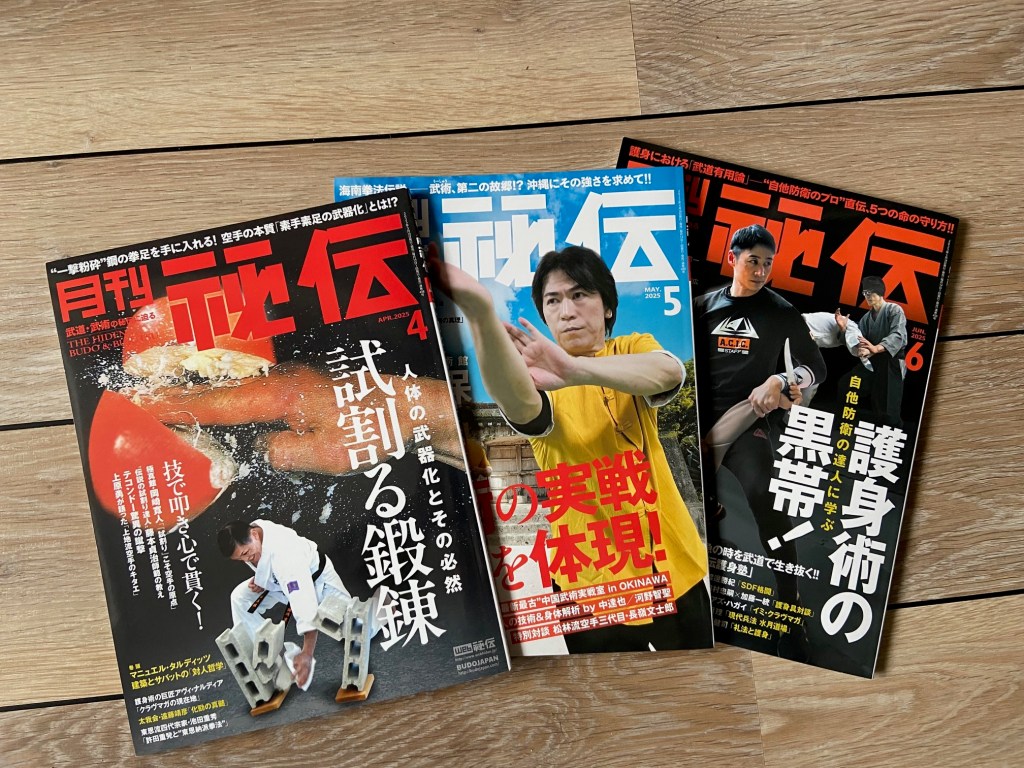
In this episode, I talk about my previously published articles (Gekkan Hiden [Japanese], Patreon & BudoJapan [English])—particularly about sourcing and discovering rare newspapers in Japan, Yabu’s role in the First Sino-Japanese War, Tokashiki Iken’s research on Higaonna Kanryō, Tō’on-ryū, Matayoshi Kobudō, Uechi Kanbun, Miyagi Chōjun, the Bubishi and Nepai, as well as future projects. Most of all, I discuss my recent research trip to Japan and Okinawa.

The calligraphy in the background (on the calendar) was drawn by Higa Kiyohiko Sensei and was a gift to me by Higa Kiyohiro Sensei.

Watch here: https://youtu.be/SsT7dOldhR4?si=hK8srysXRU7Aw3s7

⚠️ There is a small mistake in the podcast! It’s not exactly an error—it depends on which edition we’re looking at. If anyone can spot it within 24 hours, please reach out to me! The first person to recognize it will receive a free signed copy of my future book.

The new book by Tokashiki Iken

I recently bought the latest book by Tokashiki Iken and decided to translate the table of contents.

Okinawa Dentō Karate-dō

Naha-te (Gōjū-ryū) – Tomari-te (Matsumora-ha)

Exploring the Lineage of the Two Major Ryūha

by Tokashiki Iken

Table of Contents

Preface

Concept of Karate-dō

Era of Open Trade and Cultural Exchange with China

Theory of the Introduction of the „Thirty-Six Families“

The era of the Weapon ban policy.

Influence of the Satsuma Domain

Exploring the Roots of Naha-te

Sakiyama Kitoku 崎山喜徳

Sakiyama Kisen 崎山喜選

Tomigusuku Oyakata Seikō 豊見城親方盛綱

Nagahama chikudun pēchin sōhei 長濱筑登之親雲上宗屏

Higa Jūtaru 比嘉重樽

Aragaki Seishō 新垣世璋

Higaonna Kan’yū 東恩納寛裕

Kuniyoshi Shinkichi 国吉真吉

Higaonna Kanryō 東恩納寛量

Yoshimura Chōgi 義村朝義

Kyoda Jūhatsu 許田重発

Miyagi Chōjun 宮城長順

Kamiya Jinsei 神谷仁清

Ura Sōke 宇良宗亀

Higa Seikō 比嘉世幸

Shinzato Jin’an 新里仁安

Iraha Chōkō 伊良波長幸

Fukuchi Seikō 福地清幸

Special Notes: Exploring the Essence of Okinawan Karate

Exploring the Roots of Tomari-te

Teruya Chikudun Pēchin Kishin 照屋筑登之親雲上規箴

Uku Karyū 宇久嘉隆

Maeda Gichō 真榮田義長

Oyadomari Kōkan 親泊興寛

Matsumora Kōsaku 松茂良興作

Yamada Gikei 山田義恵

Maeda Ginin 真柴田義任

Kinjō Chikudun Kinin 金城筑登之紀任

Yamazato (Yamada) Yoshiteru 山里 (山田) 義輝

Kuba Kōhō 久場興保

Iha Kōtatsu 伊波興達

Nakamoto Kōsei 仲本興正

Hokama Seikichi 外間政吉

Maeda Gisei 真栄田義正

Henzan Ryōzen 平安山良善

Hokama Seijun 外間政順

Kuba Chōjin 久場長仁

Nakasone Seiyū 仲宗根正侑

Conclusion

The Public Disclosure of Karate and Its Adoption in School Education

The First Introduction of Karate to Mainland Japan

The First Introduction of Okinawan Karate Overseas

About the Different Styles of Karate

The Future of Karate-dō

Okinawa no Bugi (Jō – Chū – Ge)

Family Genealogy, Burial Sites, Ancestral Tablets, and Related Photographs

Okinawa Gōjū-ryū & Tomari-te Karate-dō Association – List of Officials

Okinawa Karate-dō Gōhaku-kai Lineage Chart

Iraha Chōkō – A Tō‘on-ryū master !!!

Iraha Chōkō 伊良波長幸 (1901-1986)

„The author had spent several years in Okinawa before its reversion to Japan. At that time, although Okinawa was small, it had a governmental structure comparable to that of an independent nation. There was a legislative body called the Rippōin, which corresponded to a national parliament, and the author often had the opportunity to visit the parliamentary building.

Whenever the author went there, he would always peek into the office of a legislator named Iraha Chōkō and often spent a great deal of time there. As for Iraha’s insight as a legislator, the author, perhaps impolitely, had never given it much thought, so he never asked about political matters.

Iraha always wore a gentle smile and spoke in a low, delicate voice, so soft that it was difficult to make out his words. Their conversations were light and scattered, consisting mostly of small talk. The atmosphere was as calm and pleasant as a spring breeze, making it an exceptionally comfortable place to be.

Though Iraha was already advanced in age, there was not the slightest trace of a martial demeanor in his appearance. He may have been well known as a calligrapher.

Years later, the author heard someone describe him by saying, “Bushi gwā yamishētan dō.” In other words, “He was a Bushi gwā.”

“Bushi gwā” refers to a person who has reached the level of a true master in Karate and is also distinguished by exceptional character and wisdom.“

—————————

I copied the following text from a book. Mario McKenna was kind enough to mention the book title to me; otherwise, I probably would have never known about it.

I brought the book back from my recent trip to Japan. Ironically, Iraha Chōkō passed away when I was just one year old, so of course, it should be impossible for me to have heard his voice… But luckily, I was able to hear it in a very old interview, and his voice was truly “a low, delicate voice, so soft that it was difficult to make out his words.”

More about this in the future !!!

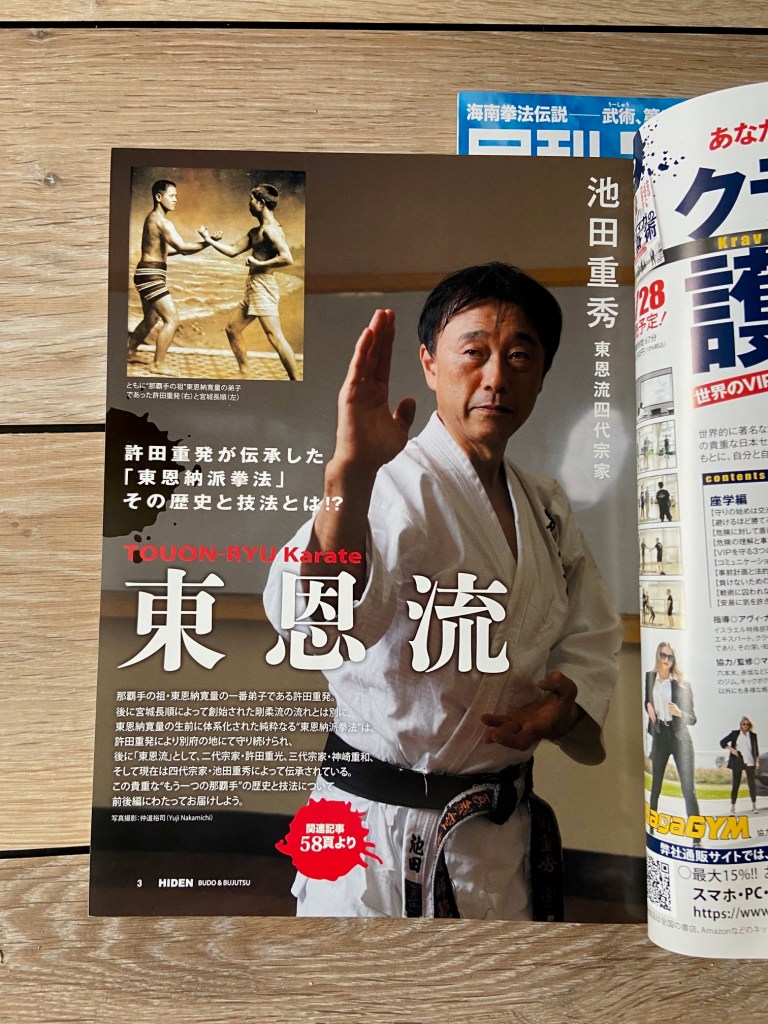
Tōon-ryū in Western Karate Books

It is no secret that I hold a deep and enduring interest in the history of Tōon-ryū. My research in this field is both extensive and ongoing, encompassing a wide range of Japanese articles and English-language publications—even when Tōon-ryū or its history is mentioned only in passing.

In this context, I would like to introduce two books that reference Tōon-ryū. However, I must also highlight some significant inaccuracies within these works. While I greatly appreciate the effort and dedication that both authors have invested in their research, I believe it is important to address these points for the sake of clarity and accuracy.

Two books

Thomas Feldmann has undertaken the commendable task of writing a book about Yabu Kentsū, which, in many respects, is well-researched and informative. Within this book, he briefly touches upon the Tōon-ryū tradition. 

Interestingly, Shigekazu Kanzaki (1928-2008), the second head of the Tō’on-ryū school of karate, told a similar story, possibly of the same origin as the one portrayed above, which he had heard from his master Jūhatsu Kyoda (1887-1968), who was Yabu’s student at the Okinawa Normal School. (page 96)

However, there are two notable inaccuracies that deserve mention:

1. Date of Passing of Kanzaki Sensei – Feldmann states that Kanzaki Sensei passed away in 2008. However, the correct date is 2018.

2. Lineage of Tōon-ryū – The book omits mention of Kyoda Jūkō (1926–1983), who was the second Sōke (headmaster) of Tōon-ryū. Kanzaki was, in fact, the third Sōke, and the current head of the school is Ikeda Shigehide, the fourth Sōke.

These details are essential in preserving the accuracy of Tōon-ryū’s historical lineage.

Another recent publication discussing Tōon-ryū is Scot Mertz’s book Ryuhoryu. While the book presents valuable insights, there are a few points that I believe warrant clarification.

Calligraphy of Nakaima Kenkō (dated 1968)

1. Misinterpretation of Calligraphy – On page 64, Mertz reproduces a calligraphy by Nakaima Kenkō. However, he mistakenly confuses the names of Kyoda Jūhatsu and his student, Iraha Chōkō. Instead of correctly identifying Kyoda Sensei, Mertz mistakenly refers to Gusukuma Kōki, another student of Higaonna Kanryō—who, however, does not appear in this particular calligraphy.

2. Diagram of Karate Styles – On page 65, Mertz presents a self-made diagram illustrating various Karate styles. The section concerning Tōon-ryū immediately stood out to me. To help clarify the misunderstandings, I would like to provide the correct names of Kyoda Jūhatsu Sensei’s students, along with the corresponding kanji:

  • Iraha Chōkō 伊良波長幸
  • Ōnishi Eizō 大西栄三
  • Kyoda Jūkō 許田重光
  • Kanzaki Jūwa 神崎重和
  • Kanzaki Shigekazu 神崎重和

It appears that the confusion may have arisen from a misunderstanding of Japanese kanji readings. The Japanese language employs two primary reading methods: the on-yomi (Sino-Japanese reading) and the kun-yomi (native Japanese reading). It seems that Mertz inadvertently listed Kanzaki Sensei’s name in both reading forms, which could mistakenly give the impression that these were two distinct individuals. I would like to clarify that this is not the case—both readings refer to the same person.

——————

In conclusion, my intention is not to diminish the valuable work of either author but rather to contribute to a more accurate understanding of Tōon-ryū’s rich history. Open and constructive dialogue is essential in maintaining the integrity of martial arts research, and I hope these clarifications serve that purpose.

I deeply respect the dedication required to research and write about these complex subjects and appreciate the efforts both authors have made. It is through such discussions that we can collectively deepen our understanding of these important traditions.

Thank you for your attention and consideration.


Our Japan Research Journey (Part II)

I have been in Japan since January 6. First, I spent a week in Okinawa—originally, I had planned to do much more, but due to a COVID infection, I was only able to visit “Shureido” and go to the library once.

Regarding the rest of the trip:

On February 9, we headed to Tokyo Haneda Airport. However, our destination was not Germany but Okinawa, where we planned to conduct research for the next three weeks.

On February 10, training started right away. I had arranged to meet Higa Kiyohiro Sensei at the Bugeikan Dōjō, with the focus on Hanashiro Chōmo’s karate. After training, I made a quick stop at a ramen restaurant before heading straight to the prefectural library.

On February 11, we met with acquaintances and family.

On February 12, at 10:00 AM, we had an interview with Ōshiro Toshihiro. This interview had been highly anticipated and meticulously planned by the German students in advance. It lasted over three hours, and Ōshiro Sensei provided us with many fascinating insights. In the afternoon, the next interview followed immediately, this time with Akamine Hiroshi.

me with Ōshiro Toshihiro Sensei (February 18, 2025)

Both interviews provided us with a wealth of valuable information, and I am looking forward to making these insights available to German karateka soon.

Interview with Akamine Hiroshi Sensei, with my friend Dell Hamby (February 18, 2025)

In the evening, I briefly met with Dell Hamby, and I am deeply grateful to him for making the interview with Akamine Sensei possible on such short notice.

From February 13 to 15, I dedicated my time entirely to friends and family, so no research took place. However, on February 15, we made a stop in Chatan to greet Shimabukuro Zenpo Sensei, whom we had the opportunity to interview last year.

with Shimabukuro Zenpo Sensei (February 15, 2025)

Also on February 15, I met a very dear new friend for dinner in Naha.

On February 16, we were invited to a private concert in Ishikawa, where we enjoyed beautiful Okinawan music.

On February 17, I had the privilege of training at the Bugeikan again with my new friends, further deepening my understanding of Hanashiro Chōmo’s karate. Afterward, we headed straight back to the library.

On February 18, we met a researcher at the Karate Kaikan and received many valuable suggestions for improving our research. Afterward, we had lunch and then visited our favorite bookstores.

On February 19, I made a quick stop at the library in the morning, followed by a meeting with friends in Naha. Later, we attended the memorial ceremony for Uema Yasuhiro Sensei.

with Uema Takeshi Sensei (February 19, 2025)

On February 20, we had a photo session at the Bugeikan Dōjō, followed by training. Later, I paid my respects to Yabu Kentsū Sensei and offered my apologies for recent events. I entered the gravesite with the utmost respect and strictly followed the proper etiquette. Afterward, I visited the “Okinawa Prefectural Museum.”

On February 21, we met with our best friend on-site (Thomas Krekel), with our destination being the “Kona Cafe” in Chatan. Then, we went straight to Shuri for a Bubishi lecture at Geijutsu University.

Lunch with our very good friend Thomas (Hawaii/Okinawa)

On February 22, I went to Shuri and visited many historical sites. Along the way, I also ordered a stamp. 😉

On February 23, we went back to the library, and in the evening, I had dinner with family.

On February 24, training at the Bugeikan was back on the schedule. Many questions were asked once again, and although it may sound a bit presumptuous, I feel like my understanding of Hanashiro’s karate is gradually deepening.

On February 25, we conducted a short interview, followed by a visit to the Yōshūkan and a stroll through Shuri.

I pretend as if I could read japanese

On February 26, I had my last training session at the Bugeikan. At the end, I received a very important and special gift, which I look forward to sharing soon. Afterward, I visited the “Naha City Museum of History”—not the regular exhibition, but the research library, which requires prior registration and a strong research interest to access.

On February 27, it was time to pack my bags, and in the evening, unfortunately, I had to say: “Until next time—2026!”

In addition to the activities mentioned, many other meetings, training sessions, etc., took place, but since they were of a more private nature, they are not included here.