Is there a film of Miyagi Chōjun from his time in Hawaii?

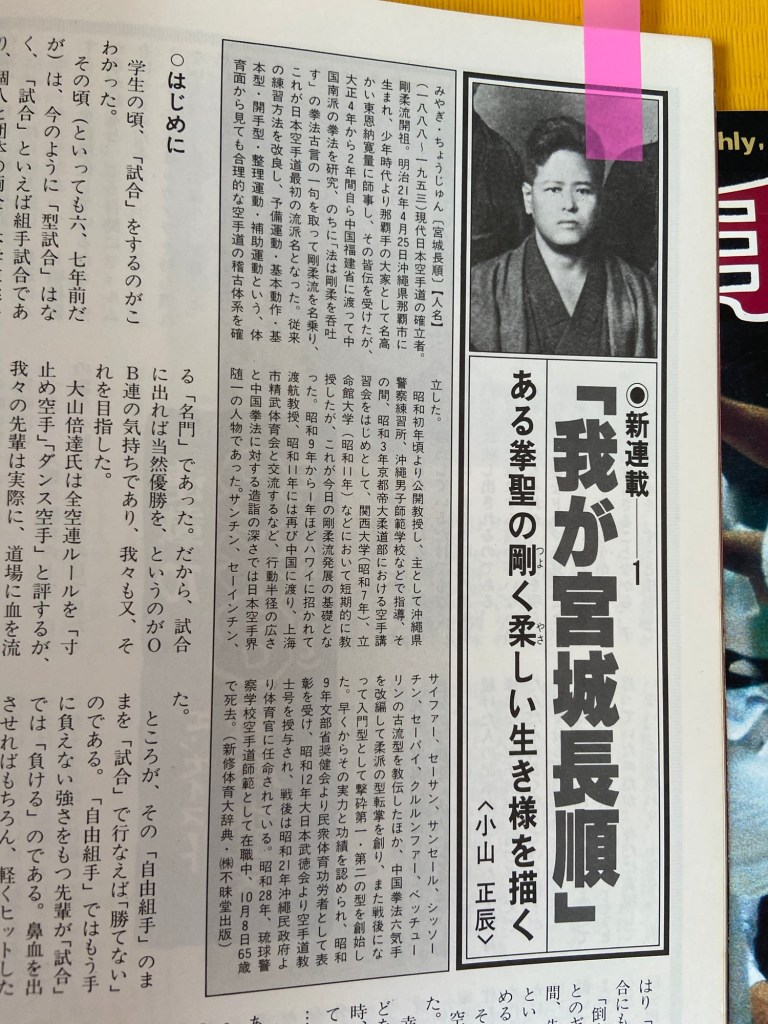
A few days ago, I was asked whether I had ever heard anything about a film recording of Miyagi Chōjun in Hawaii. I replied that, while I had read something about such a film, I view the situation with a bit of skepticism.

There is a well-established rumor among Karate researchers that Miyagi was filmed during his stay on Kauai. If such a film exists, I have not found it… yet. I did speak to an old timer who remembered an Okinawan cameraman who lived in Kekaha, Kauai, one of the areas visited by Miyagi. The cameraman reportedly moved back to Okinawa before the war – perhaps the film returned with him! – Goodin, Charles C., Chojun Miyagi’s Visit to Hawaii, Dragon Times, Vol. 17

Charles Goodin’s statements were published around the turn of the millennium. After that, it was quiet for years regarding any possible film recordings. When I received this inquiry, I recalled some comments I had read in a Gōjū-ryū Karate group in 2024. I have decided not to mention the names of those involved.

Person (1): There are rumors that in Hawaii there are old videos of Miyagi Sensei performing Katas….Oss

Person (2): Person (1) Yes. I have seen one video of him doing a version of superunpei in what looks like a town center with a group of onlookers.

Person (1): Person (2) any idea why they dnt post it? It would be Superb for the Goju Ryu practitioners….Oss

Person (2): Person (1) as I understand it the current owner of the original film wants to sell it so no public posting. I do know the film has been transferred to video.

Person (3): Person (2) did his Suparinpei look like any of his students? Yagi, Miyazato, Toguchi, etc

Person (2): Person (3) Well it’s been a few years since I saw it. I do remember it been called Pichurin by the announcer and it looked really powerful. There were a few moves I did not recognize from the version I was taught at the Jundokan but I can’t be more specific sorry.

Let it be noted here that, up to this point, I have not found any indication in Japanese sources that the kata Sūpārinpei was demonstrated at a public performance. As mentioned in my report, only the kata Sanchin, Tenshō, Seisan, and Seipai were performed.

If new information about a possible film should surface, I would of course be very happy to see that footage myself.

„Tō’on-ryū“ – History and Technique

Yokoyama Masahiko has succeeded in writing a three-part article series on Tō’on-ryū. I was already familiar with Yokoyama sensei by name, though I have never met him in person. However, I have read the book he co-authored with Mabuni Ken’ei sensei, which has been translated into both German and English.

It is worth mentioning that this current article series, appearing 22 years after the last one, is only the second (in a mainland japanese magazine) to address the relatively rarely discussed Tō’on-ryū. The previous series was published in 2003 and was primarily based on the recollections of Kanzaki Shigekazu sensei, the 3rd Sōke of Tō’on-ryū.

The current series is also the first to be published during the tenure of Ikeda Shigehide sensei, the 4th Sōke of Tō’on-ryū. While Ikeda sensei appeared in the 2003 series as a training partner of Kanzaki sensei, many of the insights in the present series are drawn from his own memories. His background as a Shitō-ryū student under Nishida Minoru sensei is also being addressed for the first time.

It should be noted upfront that Yokoyama sensei cites only a few sources in his work. Nonetheless, many of them can be easily traced. It’s also important to mention that Yokoyama sensei does not practice Tō’on-ryū himself, but comes from the Shitō-ryū tradition – a fact that is clearly reflected in his writing.

Now to the actual article series: as the title suggests, the series explores the history and techniques of Tō’on-ryū.

Issue 4/2025 begins with an overview of the style’s history. The first article is divided into the following sections:

  • The Founder of Naha-te: Higaonna Kanryō
  • Higaonna Kanryō’s Top Student: Kyoda Jūhatsu
  • Tō’on-ryū and the Elusive Tō’on Gōjū-ryū
  • Third Sōke of Tō’on-ryū: Kanzaki Shigekazu
  • Fourth Sōke of Tō’on-ryū: Ikeda Shigehide

Issues 5/2025 and 6/2025 cover the 13 kata of Tō’on-ryū, divided as follows:

5/2025:

  • Sanchin
  • Pecchūrin
  • Sansēru

6/2025:

  • Bō-Kata, Sai Kata (1), Sai Kata (2)
  • Kihon (1), Kihon (2), Kihon (3)
  • Shiho Uke
  • Higaonna Kan’yū no Seisan
  • Yabu no Jion
  • Nēpai     

As mentioned, Yokoyama sensei comes from the Shitō-ryū tradition. Accordingly, his analysis of the kata Sanchin, Pecchūrin, Sansēru, and Nēpai is especially detailed, as these forms also appear in Shitō-ryū under nearly identical names. While I don’t agree with all of his interpretations, in several instances I’ve come to the same conclusions.

It should come as no surprise – I’ve mentioned it several times before – that I am also working on an article about Tō’on-ryū. My article is not intended to compete with the series, but rather to complement it and help introduce this lesser-known karate style to readers. I see my contribution as an addition – and in some aspects even an expansion – as I will address many details that Yokoyama sensei touches on only briefly.

Before my own article on Tō’on-ryū is completed, an interview between Koyama Masashi sensei and myself will be published, planned for Issue 7/2025.

Stay tuned – there’s more to come…

Lost in Translation: Subtitle Issues and Clarifications

I was very excited when Will from “Monkey Steals Peach” announced his trip and his planned video project. However, I was already quite skeptical about certain points in advance – but that’s a whole different topic. I briefly became a Patreon supporter to watch the content earlier.

From episodes 3 and 4 onward, I was quite shocked by the subtitles, especially during the interview with Higa Kiyohiko Sensei – I found it particularly frustrating. The subtitles have since been revised; in my personal opinion, they are still not perfect – but clearly much better than the ones that were originally produced. Just a small correction from my side – in the interview, Higa Sensei speaks of Yamani-ryū, not Yamane-ryū – he’s basically using the Okinawan pronunciation here rather than the Japanese one. The Yamani-ryū that is practiced and preserved at the Bugeikan Dōjō is a great treasure – it comes very close to how Chinen Masami demonstrated it in 1961.

Today I watched Will’s apology, and I can tell him that he is not the only one who had issues with the subtitles – even in the much-praised episode of Kung Fu Quest, there were similar problems. I really appreciate that he apologized for his mistakes – that shows STRENGTH. It’s increasingly noticeable lately that many people, especially via print-on-demand platforms, quickly change the criticized points and act as if it had always been that way… which is, of course, not true.

THANK YOU MONKEY STEALS PEACH (WILL) FOR YOUR HONESTY.

The example of Higaonna Morio Sensei and Kung Fu Quest:

from 32:30 min on (!)

Chinese TV translation:

I was told Ryu Ryu Ko was a guard. He was about 40 years old. Tall with powerfull foot movements. Because oft he civil wars he went to many places and learned many different kung fu. He might have learned Crying Crane boxing. In the past learning martial arts had to be done covertly. Kanryo went to China because his father had been beaten to death. He wanted to learn kung fu for revenge. Because Kanryo Higaonna was illiterate many things had not been passed down. What is the truth? Was the name Ryu Ryu Ko real or false? No one knows.

What Higaonna Morio really said in Japanese:

正確には、分からん。とにかく、リューリューコウとしてはね、あのーお寺で、元々仕事はまぁ護衛官ですよね。この福建の王様の時代ですよね。お城があって。護衛官なんですね。セキュリティ。

で、内乱が起きたもんだから、地下に潜ったと言うんですね。ほとんど、半分は逃げたと。最初に逃げるのは、ベトナム、東南アジアと。この人はだから、、、あの、、、たくさんあった少林寺のお寺があったんですね。流派はまだ聞いてないですけど、あのーよく鳴鶴と言う、、、、(フェイドアウト)

Translations of the real words of Higaonna Morio:

To be precise, I don’t really know. Anyway, as for Ryū Ryūkō, well, at the temple, his original job was, you could say, a bodyguard. That was during the time of the viceroy of Fujian, right? There was a castle. He was a bodyguard—security.

Then, because a civil war broke out, it’s said he went underground. Apparently, about half of them fled. The first to flee went to Vietnam and Southeast Asia. So this person… um… there were many Shaolin temples, you see. I haven’t heard which school yet, but, um, he was often referred to as „Whooping Crane“… (fades out)

Mein erstes Karate-Buch (Deutsch)

Gestern habe ich angekündigt, dass ich ein stark limitiertes Buch über Karate auf Deutsch veröffentlichen werde. Das Buch ist in einer Auflage von lediglich 100 Exemplaren geplant – davon werden nach aktuellem Stand fünf Exemplare an Institutionen gehen. Somit werden nur 95 Bücher regulär erhältlich sein.

Geplant ist ein hochwertiges Hardcover-Buch, das auf Wunsch selbst-verständlich von mir signiert werden kann.

Zum Inhalt:

Das Buch basiert auf insgesamt acht Artikeln, die zunächst im japanischen Gekkan Hiden-Magazin erscheinen bzw. bereits erschienen sind. Vier dieser Artikel sind bereits veröffentlicht.

Artikel 1 – Yabu Kentsū

Ein Nachruf auf Yabu Kentsū, ursprünglich verfasst von Hanashiro Chōmo. Dieser Artikel ist bereits veröffentlicht, wird jedoch in der Buchversion deutlich erweitert erscheinen.

Artikel 2 – Jion

Dieser Artikel zur Kata Jion ist kein Lehrtext zur Ausführung der Kata, sondern behandelt deren Geschichte und Übertragungslinie. Er basiert auf alten Zeitungsartikeln, Feldforschung sowie Interviews mit Experten aus Okinawa und Japan.

Artikel 3 – Karate in Hawaii und Brasilien

Behandelt werden zwei bedeutende Karate-Demonstrationen außerhalb Japans. Auch dieser Artikel wird für die Buchveröffentlichung stark erweitert und beinhaltet wenig bekannte Inhalte.

Artikel 4 – Miyagi Chōjun auf Hawaii

Ein detaillierter Bericht über Miyagis Reise nach Hawaii. Dieser Artikel wird nahezu unverändert in das Buch übernommen.

Weitere Inhalte:

Zusätzlich werden vier weitere Artikel enthalten sein, die ebenfalls unbekannte Aspekte der Karate-Geschichte beleuchten. Ergänzt wird das Buch durch zwei bis drei Interviews, die direkt aus dem Japanischen übersetzt und erstmals veröffentlicht werden.

Fazit:

Es bleibt also spannend !!!

ChatGPT – A Helpful Tool in Karate Research?

Recently, I had a conversation with my wife about the use of ChatGPT in historical karate research. We discussed both the opportunities and the challenges that this technology presents.

Our conclusion was that, at present, ChatGPT should be approached with caution when it comes to serious historical research. One key reason is its limited access to up-to-date academic sources and archives – especially publications released after 2019 are often not included in its database. Yet it is precisely these more recent findings that offer valuable insights.

In addition, ChatGPT’s automatic translations are not yet entirely reliable. They may contain inaccuracies or omissions, and Okinawan names are frequently transcribed incorrectly.

Therefore, it’s important not to rely solely on AI-generated information. Instead, such tools should be seen – if used at all – as supplementary aids that must be accompanied by careful source criticism and sound expert knowledge to avoid misunderstandings or unintended misinformation.

The Shotokan Dojo (1939-1945)

The Shōtōkan Dōjō, founded by the Funakoshi family, was a landmark in the history of modern karate. Widely recognized and documented at the time, it stood as a symbol of the martial and spiritual path. Its destruction in the 1945 air raids on Tōkyō marked a tragic cultural loss amid the devastations of war.

Yogi Josei Sensei (1934–2025)

Exactly one month ago today, I learned of the passing of Yogi Josei Sensei. Miguel R. informed me of this sad news via Facebook Messenger. I made the personal decision to wait a month before writing down my thoughts — my prayers were already directed on the day of the news to his soul, to his family, and to the students of Yogi Sensei.

Yogi Sensei correct my Eku-Kata (2014)

Before I met Yogi Sensei for the first time in 2008, I had already heard many stories about him, all describing his compassionate character. So, when I finally met him in 2008, it wasn’t much of a surprise.

Yogi Sensei, Miguel and me (2014)

At that time, Jhonny Bernaschewice allowed me to travel with him and his group to Okinawa. We flew from Frankfurt am Main via Taipei to Okinawa, where we had the opportunity to train for nine days under Gakiya Yoshiaki and Yogi Josei. Since I had only started practicing Okinawa Kobudō in 2007, I began with the Hojo Undō (1–3) and the kata Shūshi no Kon. From there, I trained directly under Yogi Sensei, while the advanced students continued practicing higher kata with Gakiya Sensei. Yogi began to intensively teach me Shūshi no Kon.

Okinawa Budōkan (2012)

On the first day, we met Gakiya and Yogi directly at the Budōkan, and from the second day on, Yogi began picking us up from our accommodation. Every time, he arrived in his “Nissan Scout,” loaded all the into the car, and drove me to the Budōkan. During the drive and in the parking lot, he would tell me many stories from his youth in Okinawa — for example, how American soldiers provided him with chocolate after the war — a story quite similar to one I heard from my grandfather, who was also given chocolate by English soldiers. Yogi Sensei also told me how Heiwa-Dōri was once underwater and how shopping there was no longer possible.

Yogi Sensei teach me Kōnan-ryū 硬軟流 (2009)

A few times, he would open his trunk and give me two gifts — one for Jhonny Sensei and one for me. This is how I, among other things, had the honor of receiving a program booklet from the memorial ceremony for Itokazu Seiki Sensei, the father of Itokazu Seishō Sensei.

After every training trip, Yogi would take us to the airport. He always struggled to hold back tears — saying goodbye was hard for him each time, and he looked forward to seeing us all again the following year.

After Gakiya Sensei fell ill, Yogi took over sole training of our group for the first time. There were a few changes in some kata — Yogi began teaching his own interpretation of Kobudō and also founded his own organization: Okinawa Kobudō Renseikai. After consulting with Jhonny, I began traveling to Okinawa independently from 2012 onwards, and over the next two years, I received, among other things, private lessons from Yogi Sensei. He taught me his Nunti-kata, Ufuton-bō, and his Jō-kata, and continued to train me intensively in other weapons (Bō, Sai, Tunkwā, Nunchaku, Eku).

We practiced the Nunti-kata at the time with my rattan bō, which had a point on one end. Yogi explained this as the spear tip. The first few times, he would always laugh when the spear tip wasn’t in the correct position at the end of the kata.

Once, while eating at an Okinawan restaurant, he asked me if I knew “Ashi-sumō,” and he began to practice it with me. According to him, he had already practiced it as a child with other kids.

The last time I saw Yogi Sensei was at the Budōkan in 2024. He told us about his Beiju celebration (88th birthday), and I met his son for the first time, who continued to drive him to the Budōkan every Monday, Wednesday, and Friday so that Yogi Sensei could continue to follow his calling.

Sensei-ni-rei

Gabu Seikei (2) – Possibly a Photo of Him

Yesterday, I wrote about Gabu Seikei, a former karate teacher at the First Middle School in Okinawa.

According to Tokuda Antei, Gabu and Hanashiro began teaching karate at the same time. A newspaper report confirms that karate training had already started at the beginning of 1905 (Ryūkyū Shinpō, 1905). This was during the time when Yabu Kentsū was serving in the Russo-Japanese War (1904–1905), which further suggests that it was indeed Gabu who was teaching alongside Hanashiro (Ryūtan, 1938). Yabu returned in 1906 and began teaching at the Normal School (Ryūkyū Shinpō, 1906).

Thanks to the excellent research by Andreas Quast, we also know that Gabu was active during the same period as Hanashiro (Quast, 2024). Putting all this information together, it seems there is a small possibility that the man standing next to Hanashiro in the photo could be Gabu Seikei.

Middle row: Gabu Seikei (???) and Hanashiro Chōmo

Note: The photo analysis was done by me. I relied on the words of Tokuda Antei. The picture—originally found by Nakamura A.—possibly shows Itosu Ankō and definitely includes Hanashiro Chōmo.

Gabu Seikei (1)

Gabu Seikei is a relatively unknown karateka, but he wasn’t just a karateka, he was also one of the first soldiers from the Prefecture of Okinawa. Together with Yabu Kentsū, Hanashiro Chōmo, and seven other Okinawans, Gabu joined the NCO School in Chiba Prefecture, becoming a soldier as well (Yabu, 1932a).

During my review of the original 1961 text,
February 25, 2025.

However, he has largely been forgotten in karate circles. His name, for instance, has often been mistaken as a typographical error for Yabu’s name, as shown in the following two examples—both of which are copies of a text by Tokuda Antei (Yōshū, 1961).

„Karate was first initiated by Hanashiro Chōmo sensei and Yabu Kentsū sensei, along with around 28 enthusiastic students, at the site of the former Shuri Tōnokura National School (now within the premises of the Okinawa Bank), where we began practicing fundamentals such as Naihanchi.“ (Hokama, 1984).

„Karate was first initiated by Hanashiro and Yabu (with ‘Ga’ noted as a mistaken character for ‘Ya’), along with around twenty enthusiastic students, at the site of the former Shuri Tōnokura National School (now within the premises of the Okinawa Bank), where we began practicing fundamentals techniques such as Naihanchi.“ (Kinjō, 2011)

Hokama Tetsuhiro, in preparation for his first book, conducted extensive research and interviewed numerous masters of karate. Kinjō Hiroshi, a former student at the Okinawa Middle School and a direct student of Hanashiro Chōmo prior to World War II, was also well-connected within the Okinawan martial arts community.

It appears that Gabu’s name had already faded from public recognition even before the war. According to the recollections of Yabu Kentsū, Gabu served in the 13th Company (Yabu, 1932b) and also participated in the First Sino-Japanese War (1894–1895), including the Battle of Weihaiwei. (Ryūkyū Kyōiku, 1896).

However, Gabu is believed to have passed away sometime before 1932. Yabu notes that five former attendees of the Non-Commissioned Officers (NCO) School held biannual meetings (in spring and autumn), and Gabu’s name is not among those listed. (Yabu, 1932b).

Unfortunately, it remains unknown from which master Gabu Seikei may have learned karate. At this point, I will refrain from making any speculations.

One final note: Tokuda Antei (徳田安貞, 1884–1979) cannot be the son of Tokuda Anbun (徳田安文, 1886–1945), as I recently read elsewhere.

Reflections on the Role of a Literary Critic in the Field of Okinawan Karate History

From time to time, new ideas take shape in my mind, only to be set aside again after brief reflection. One such idea was to write well-founded reviews of publications related to the history of martial arts. However, the central conflict lies in my own attitude: I cannot—and do not wish to—gloss over the truth. My aim is to offer honest assessments, even if they may occasionally be perceived as uncomfortable.

There is a well-known phenomenon in public discourse: during international football tournaments, millions of “national coaches” suddenly emerge—people who otherwise show little interest in the sport but express their opinions with great confidence. A similar accusation could perhaps be made about me. However, I have a broad base of sources at my disposal; I have read many of the relevant works myself, and others are in my personal library and can be reviewed at short notice.

What strikes me is the increasingly frequent use of terms such as “well-researched,” “no source left out,” or “extensive literature review.” These expressions suggest a thorough academic engagement which, upon closer inspection, often proves unsubstantiated. It raises the question of whether all relevant sources were truly identified and correctly understood.

Should I decide to pursue the writing of reviews more regularly, it would likely not be without friction. Authors might feel personally attacked by critical comments, and readers, too, could view my open approach with disapproval. Honest criticism is often praised in theory, but in practice, its consequences are not always welcomed.

A comparison from everyday practice: in the field of karate, it is not uncommon for videos of kata performances to be critically discussed on social media. In many cases, this is even encouraged by the performers themselves, who, by sharing such recordings, actively seek feedback—both positive and critical. In this context, a conscious engagement with content is sometimes explicitly desired.

In the world of book publishing, however, a comparable level of openness is still rare. Critical reviews—especially negative ones—appear to be unwelcome. Rather than a nuanced examination of content and methodology, there is often a prevailing desire for praise and superlatives, which do not always correspond to the actual quality of the work.