Building a House – Regarding the soon-to-be-released Tō‘on-ryū article

I believe it is no secret that we are working on a Tō‘on-ryū article. Recently, a question arose about when the article will be published.

The recently released article about Yabu Kentsū is the path to the house, the upcoming articles will be the different house connections and the foundation, and the 6th article will then be the Tō‘on-ryū article (the HIGHLIGHT – aka the House).

Various things need to be initiated before we can write in more detail about Kyoda Jūhatsu sensei.

Lack of ideas ???

Today, I had a brief discussion with my wife about future projects. As already mentioned, the first series of articles will contain 9 articles, and after that, our first article (Gekkan Hiden 2024/1) will continue. Roughly estimated, we could end up with 18 (!) articles.

But what comes after that??? Lack of ideas?

Of course not – I have many more thoughts that just need to be put into text form. Our articles will accompany you for many years to come.

Status Update from June 19, 2024

Today, we were delighted to receive two author copies of the current issue of Gekkan Hiden (Monthly Secret). The article is „perfect“; it appeared exactly as we had envisioned. Our goal was to present Hanashiro Chōmo’s words in their unaltered form. Therefore, we decided not to change any of the characters Hanashiro used or to use a modern variant.

This proved to be quite challenging, but with the help of the publisher and several emails (from Germany to Japan / from Japan to Germany), we managed it – and the quality is breathtaking. Unfortunately, a few errors slipped into the German version.

Article #1 and Article #2

The response to the article has also been fantastic; we were honored for the quality of the article by the highest circles – Motobu Naoki sensei kindly wrote a few nice lines about it.

As previously mentioned, the third and fourth articles have already been submitted to the publisher, and I will announce the details in due course. Additionally, my wife is currently working on transcribing our interview with Uema Yasuhiro sensei (January 18, 2024). Both father (Uema Yasuhiro sensei) and son (Uema Takeshi sensei) were very gracious interview partners and warmly welcomed us with open arms. The interview will hopefully be published later this year and will serve as a source for at least „three“ articles.

Two new books are out in a few weeks

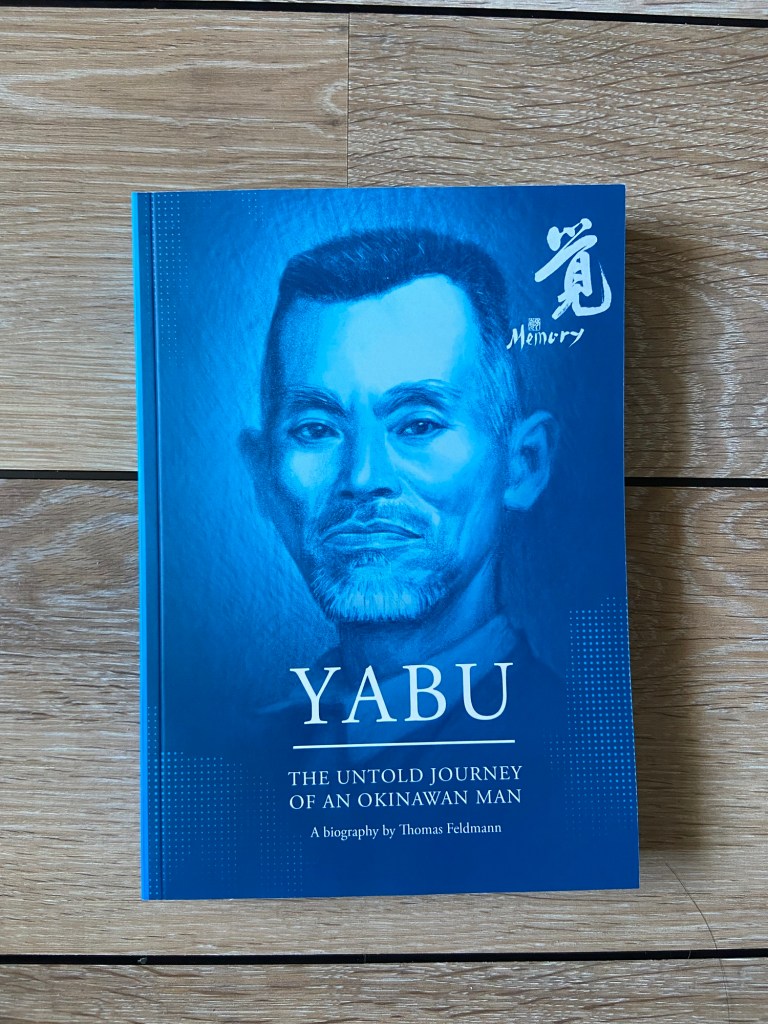
In the last few days, two new pieces of information about new books have come to light. Firstly, after three years of intensive work, T. Feldmann has completed his book on Yabu Kentsū and announced that it will be published this summer. Secondly, Katherine Loukopoulos has also announced that she has finished her book. To my knowledge, her book is an autobiography. Loukopoulos sensei played a crucial role in introducing Matsubayashi-ryū to Germany.

I am very excited about both books and will definitely buy them, as both topics greatly interest me. I am very curious to see if Feldmann’s research will answer my personal questions.

  • When exactly was Yabu sensei born?
  • From when to when did he train under Matsumura Sōkon?
  • Which kata did Yabu sensei learn/teach?
  • What was the actual reason for his long stay in the USA?
  • What did Yabu sensei do during his time in the USA?
  • Did all four sons learn karate from their father?
  • What is in Yabu Kentsū’s military record?
  • What remains of his karate overview? Which styles teach kata that trace back to Yabu sensei, and what makes these kata so special?
  • The author also had contact with two grandsons of Yabu Kentsū sensei – Yabu Kenjiō (second son of Yabu’s second son, Ken) and Norman Yabe (second son of Yabu’s fourth son, Kenneth „Kenshirō“). What could the two grandsons or their children tell Feldmann about their grandfather?

Feldmann has already proven himself with his Itosu Ankō book. This time, too, he will not disappoint any readers, and my questions will surely be answered 100% in the book.

I wrote to Loukopoulos sensei personally some time ago, and I would like to renew my statement here: „If she were a man, her role in Okinawa Karate/Ryūkyū Kobudō would be much more recognized.“ But the world is as it is. However, for me, she is one of the greatest foreign karateka to have lived in Okinawa. She trained, sweated, fought, won medals, and took extensive notes.

Karate research remains exciting!!!

Lost in Translation

Mittlerweile ist mein erster übersetzter Artikel in Deutschland erschienen. Ich bin sehr glücklich darüber, doch leider war der Fehlerteufel nicht untätig. Es haben sich zwei Fehler eingeschlichen, auf die ich gerne hinweisen möchte.

Es heißt zwar „Fehler sind menschlich“, ich hatte aber vor, keine zu begehen, und es macht mich unglücklich, diese begangen zu haben. Aber man sagt ja auch, dass man aus Fehlern lernt, was ich natürlich beherzigen will, und ich verspreche, in Zukunft diese nicht zu begehen.

Bitte verzeiht mir diese Fehler …

Ich schrieb an einer Stelle von Matsumura Sōkon. Die Übersetzung müsste richtig heißen:

„Sie besaßen einen starken Körperbau und waren von äußerst guter Kondition sowie außergewöhnlicher Körperkraft. Sie studierten bei dem ehrwürdigen Matsumura, dem großen Meister des Karate-dō und dem einzigen Meister in unserer Präfektur [Okinawa], und meisterten das letzte Geheimnis des Karate.“

Sowie die Fußnote 30, wo es richtig heißen müsste:

„Tatsächlich kam er am 25. März 1927 auf Hawai‘i an.“

Yabu no Jion

Or How I Learned This Kata

During my last stay in Beppu, I had the opportunity to learn „Yabu no Jion.“ On the first day of training, Ikeda sensei told me that my work task for the stay would be „Sanseru“ and „Kihon San“—in addition to corrections and a lot of Kihon practice.

During the week, after I could remember Kihon San, which is actually a preparation kata for Jion and Pecchurin, the topic of Jion came up. Ikeda sensei asked me if I knew a version of Jion. Indeed, I did—in my old Shōtōkan days in Germany, it was my favorite kata. After I demonstrated the Shōtōkan version, Ikeda sensei decided that I should also learn the Tō’on-ryū version of Jion, also known as „Yabu no Jion.“

Actually, „Yabu no Jion“ differs a lot from the Shōtōkan version. It’s closer to the version of Hanashiro Chōmo, which is also a very unique kata.

In my opinion, this kata showcases many of Yabu’s teachings and clearly reflects his idea of Karate.

We are very fortunate that Yabu Kentsū decided to teach the kata to Kyoda Jūhatsu and that Kyoda sensei passed it on to three of his students (his son, Iraha Chōkō sensei, and Kanzaki Shigekazu sensei).

„Yabu no Jion“ is now a significant part of my Karate training.

Announcement: I can’t teach or show you the kata. If you really want to learn it, the only place on Earth is Beppu, Japan.

I spent my last weekend in Baden-Württemberg – of course for research ;-)

I spent last weekend in South Germany attending an Okinawa (Matayoshi) Kobudō seminar with Ōshiro Zen’ei sensei. It was actually the first time I met and trained under Ōshiro sensei. The style isn’t new to me; I’ve been training in Okinawa Kobudō since 2007.

Ōshiro Zen‘ei sensei and me – Pforzheim (May 12, 2024)

My wife and I had the great pleasure of interviewing Ōshiro sensei, and he was very friendly in answering our questions. We also asked him about the Sansērū Kata of the Shōdōkan and his training under Matayoshi Shinpō sensei.

After many years, I also had the chance to see my friend Andreas Quast again. We last met in person at my wedding party in 2018 – Andreas came all the way from South Germany to attend. Now it was my turn to visit him in South Germany.

Andreas Quast and me – Pforzheim (May 11, 2024)

We talked a lot about Okinawan Karate and Kobudō, including Yamannī-ryū, Yabu Kentsū, Hanashiro Chōmo, Bō-Jutsu in general, and our future plans.

Our last stop was the Hohenzollern Castle in Hechingen, where we spent two days for my research into Jūdō history about the Hohenzollern. Sadly, it was without benefit.

Burg Hohenzollern (May 14, 2024)

My new article series !!!

On February 10, 2024, Ikeda sensei asked us to write a historical article for Tō‘on-ryū. Before this, we had gifted him our first article about an unknown karate demonstration, which we wrote for the January issue of Gekkan Hiden. He saw my wife’s writing style and was quite impressed.

Over the years, I have collected a lot of historical material about Tō‘on-ryū. However, my intention wasn’t just to copy other material and republish it later in Japanese. My wife is currently working on a book about Higaonna Kanryō, and Higaonna Kan‘yū will also play a small role. But what about the other teachers of Kyoda Jūhatsu sensei? Actually, in Japanese, not much information is known about Yabu Kentsū, one of Kyoda sensei’s teachers.

English written articles about Yabu Kentsū

So, I decided to write about Yabu sensei before continuing my journey into Tō‘on-ryū.

My first article will come out exactly one month from now, on June 14, 2024. It will be the start of a whole article series. And it will also be the introduction of the “Jion” article. How can I write about Jion without mentioning Hanashiro Chōmo and Yabu Kentsū? It is like writing a karate book without any karate knowledge.

Paying my respect at the tomb of Yabu Kentsū (January, 10th 2024)

——————————

And yes, I know that Mr. Feldmann is currently working on a biography of Yabu Kentsū. I have shared a bunch of material with him since 2021, as I did before with his first book, the Itosu Ankō biography.

Until he publishes his book, there will be no English translation from my side. I wish Mr. Feldmann all the best for his future book, and I hope that the material I sent him in the past is still a big help to him.