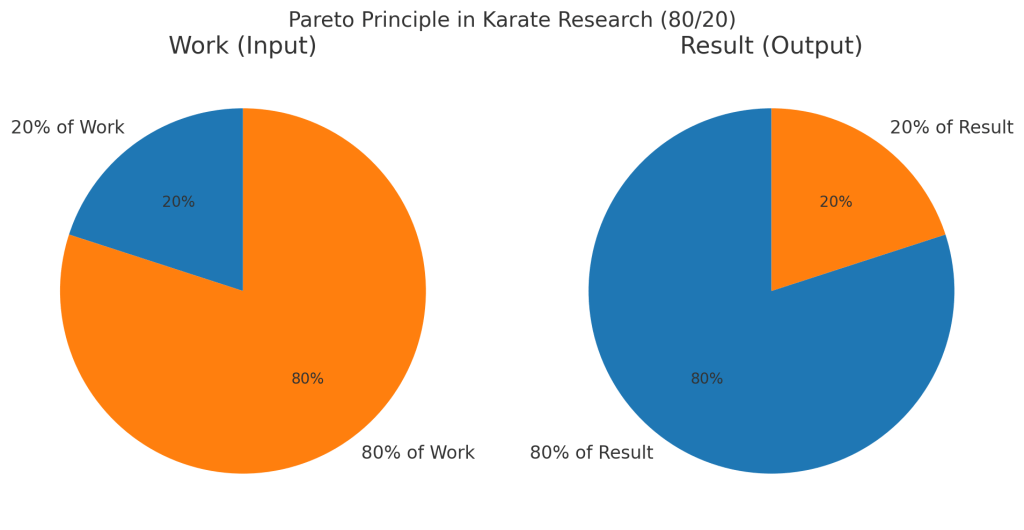
20% Work, 80% Result: The Pareto Principle

Left (Input): 20% of the work vs. 80% of the work.

Right (Output): That small 20% produces 80% of the result, while the other 80% of the work leads to only 20% of the outcome.

Doing 80% of the work for only 20% of the insight can seem very daunting, partly due to limited time and resources… but sometimes all it takes is finding the right key.

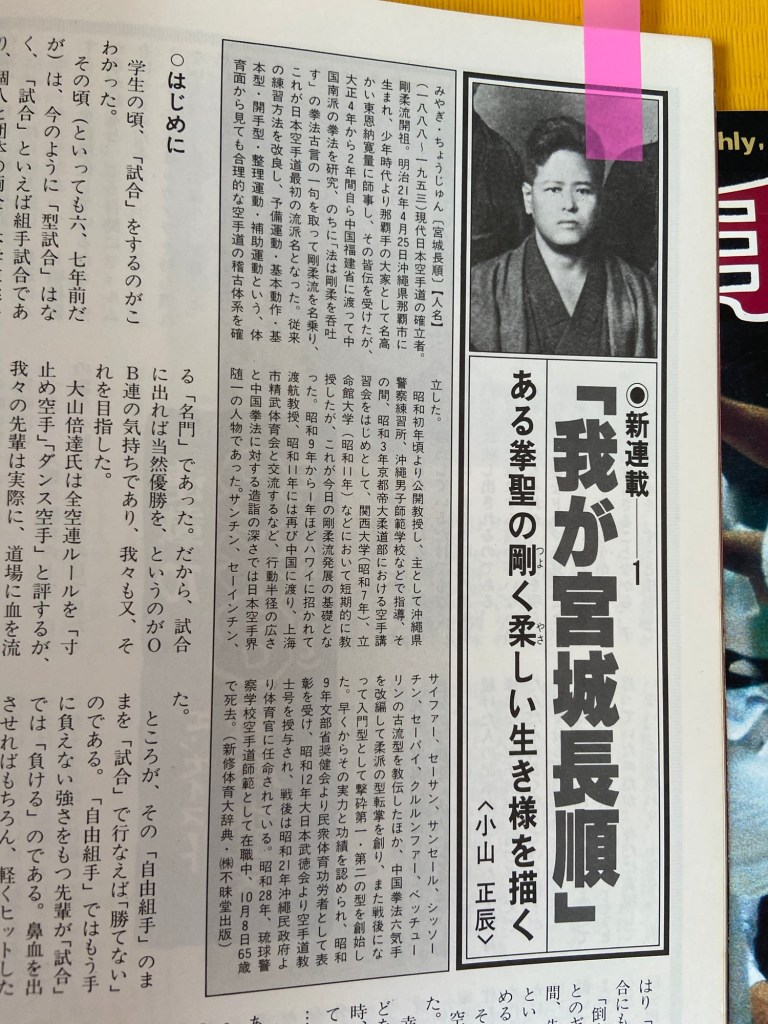
What makes Koyama sensei’s Miyagi Chōjun series so special?

Koyama traveled to Okinawa for a thesis project at Kyoto University—back in 1977—and the focus of his trip was the founder of Gōjū-ryū Karate-dō. As a small side note: around 1977, there were hardly any books or writings on Miyagi or Gōjū-ryū for comparison.

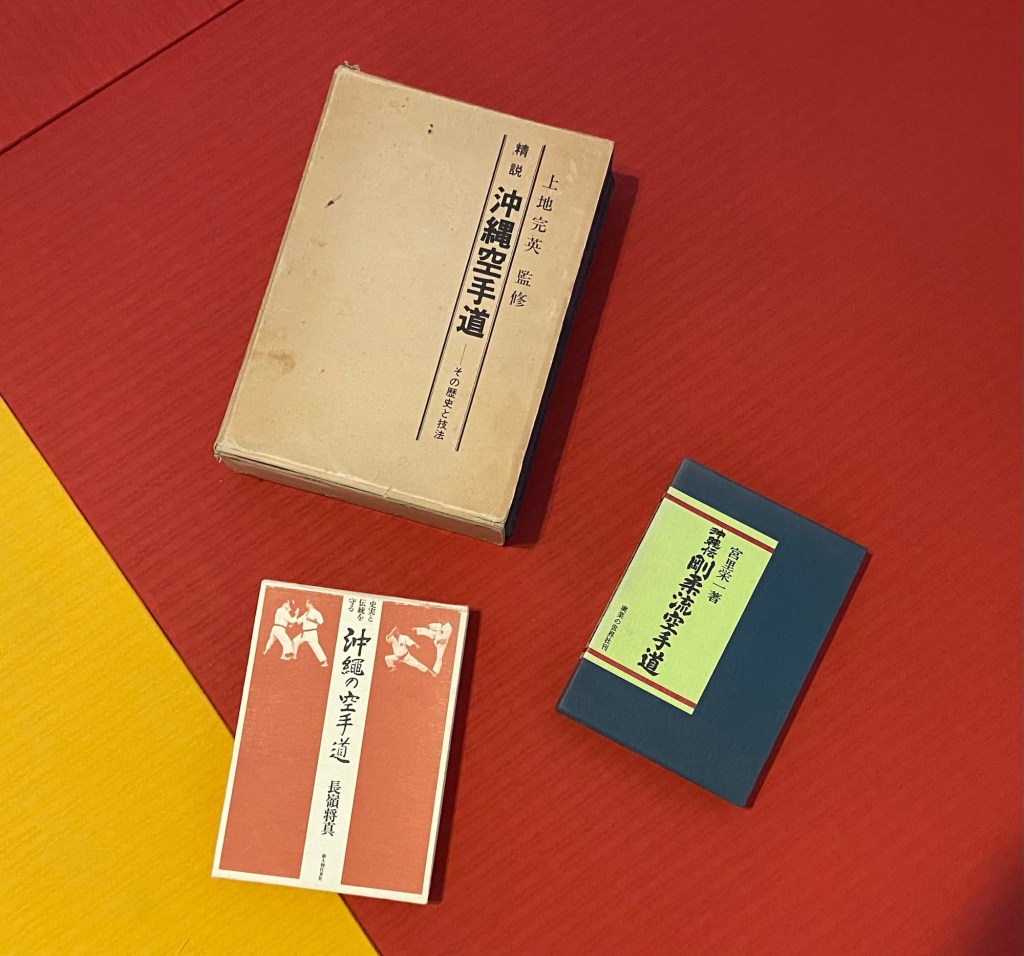
Books by Uechi Kan‘ei (1977), Miyazato Ei‘ichi (1978) and Nagamine Shōshin (1975)

This was one year before Okinawa-den Gōjū-ryū Karate-dō (1978) by Miyazato Ei’ichi sensei was published, two years after the 1975 book by Nagamine Shōshin appeared, and in the same year as the book by Uechi Kan‘ei.

It was, therefore, an early pioneering work in Gōjū-ryū research and on Miyagi Chōjun.

Although Koyama sensei is not an Okinawan, that is actually an advantage—namely, his neutrality. He was able to do something that Okinawans affiliated with a dōjō could not: he could speak with every karateka who had personally known Miyagi—and that is exactly what Koyama did.

He spoke not only with Miyagi’s students, but also with family members, such as Miyagi sensei’s second daughter and fourth son.

The series therefore describes Miyagi’s life in considerable detail. Naturally, research has progressed in the years since; new findings have been made and rare documents discovered that were not available to Koyama at the time. Footnotes will be added for these, carefully adapted and included after consultation.

So there is still more to look forward to.

My Miyagi Chōjun – by Koyama Masashi – First English Translation

Koyama Masashi sensei has been a well-known figure in Gōjū-ryū research in Japan for many years.

My Miyagi Chōjun series

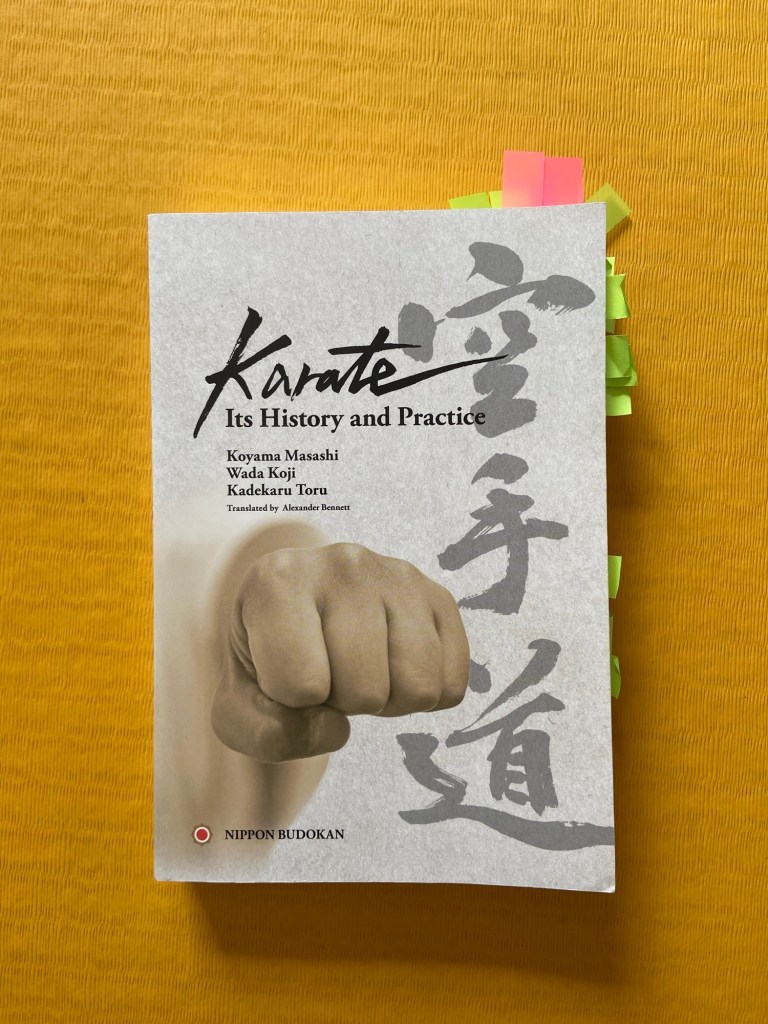
Internationally, he became particularly known through the book Karate – Its History and Practice, which he co-authored with Kadekaru Tōru and Wada Kōji.

Starting as early as 1980, Koyama published a 15-part series about Miyagi Chōjun (plus an additional article about his trip to Shanghai). In addition, many other contributions appeared, including an article about Higaonna Kanryō and an interview with the famous researcher of Chinese martial arts, Matsuda Ryūchi.

Incidentally, he demonstrated the kata Saifā in the famous series Nihon Budō Taikei.

But next to his excellent research, he was also a world champion in kata, and was de-throned by Sakumoto Tsuguo (Ryū‘ei-ryū).

My wife and I are fortunate that Koyama sensei has given us permission to translate his earlier series into English. At first, however, it will be a limited edition. If anyone is interested, please feel free to contact me. The text has been fully typed up and is waiting to be translated—may the translation begin !!!

After much consideration, I would like to publish the book in perfect quality, as a hardcover edition with a ribbon marker and other fine details.

Behind the Scenes: How We Prepare for Our Interviews

I was recently asked how we prepare for our interviews.

A few sources (japanese only)

The answer, of course, is through reading. This means researching sources in advance, examining and translating them, and then formulating questions based on that research. These questions usually arise from points that emerged during the investigation but were not clearly explained in the sources — areas where I seek more detailed information.

Our next interview to be published will be our conversation with Higa Kiyohiko Sensei.

Interview – Headline

In this case, our main focus was on the karate of Hanashiro Chōmo, as well as Yamanni-ryū, which is also preserved at the Bugeikan.

A Helping Hand

It always fills me with joy and satisfaction to support fellow Karateka – even when my help isn’t explicitly acknowledged or met with a simple “thank you.”

I often capture a screenshot before and after offering my small support – and every time, the small difference brings a smile to my face.

Of course, I’d also be happy to receive a small word of thanks – a simple gesture with great meaning. 😉

Shōrin, Shōrin, or Shōrin – but not Shorin

A few days ago, I wrote a short article about the different ways to write Kōdōkan, and I’d now like to draw attention to a similar case – this time concerning Shōrin – which also comes with varying readings.


1. 小林流 – Shōrin-ryū / Kobayashi-ryū

Reading:

  • 小 (shō) → small
    • On-yomi: shō
    • Kun-yomi: chiisai
  • 林 (rin) → forest
    • On-yomi: rin
    • Kun-yomi: hayashi
  • 流 (ryū) → style / school / stream
    • On-yomi: ryū

Meaning: „Style of the small forest“

Origin / Context:
This writing is typical for the Shōrin-ryū style of Okinawan Karate founded by Chibana Chōshin (1885–1969). The kanji were deliberately chosen to evoke a connection to the Chinese Shaolin, but use different characters that are more familiar in Japanese and perhaps stylistically softer. Chibana also wanted to emphasize his own interpretation through this choice.


2. 少林流 – Shōrin-ryū / Sukunaihayashi-ryū

Reading:

  • 少 (shō) → few, young
    • On-yomi: shō
    • Kun-yomi: sukunai, sukoshi
  • 林 (rin) → forest
  • 流 (ryū) → style / school

Meaning: „Style of Shaolin“ (literally: „Style of the young forest“)

Origin / Context:
This is the classical Chinese writing for Shaolin – 少林 (Shàolín in Chinese). In Japanese, it is also read Shōrin. This version appears in more historically or Chinese-oriented contexts, such as when emphasizing the origin from the Shaolin Temple.

In Okinawan Karate, this writing is used in styles that trace back to Kyan Chōtoku, such as Shōrin-ryū Seibukan (Shimabukuro Zenryō) and Shōrinji-ryū (Nakazato Jōen).


3. 松林流 – Shōrin-ryū / Matsubayashi-ryū

Reading:

  • 松 (shō / matsu) → pine (tree)
    • On-yomi: shō
    • Kun-yomi: matsu
  • 林 (rin) → forest
  • 流 (ryū) → style / school

Meaning: „Style of the pine forest“

Origin / Context:
This variant is used in Matsubayashi-ryū, founded by Nagamine Shōshin. „Matsubayashi“ is an alternative reading of the kanji for Shōrin (松林). The name was intentionally chosen as an homage to Matsumora Kōsaku and Matsumura Sōkon, while matsu (pine) is also a symbol of constancy and purity.

Some schools pronounce this writing as Shōrin-ryū, others as Matsubayashi-ryū, depending on how they emphasize their stylistic heritage. In Western literature, both versions are commonly found – for example, Matsubayashi Shōrin-ryū.


An Exception: 書林 – Shorin

This writing appears in an English-language publication where I once mistakenly read it as Shōrin.


書林 – Shorin

Reading (On-yomi):

  • 書 (sho) – book, writing, script
  • 林 (rin) – forest, grove

Meaning:

  • Literally: “Forest of books” or “Grove of writings”
  • Figuratively: publisher, bookshop, place of literature

The term 書林 is also used metaphorically in classical Japanese and Chinese literature to denote:

  • a place of learning
  • a center of literary activity
  • or even a printing house or publishing establishment, particularly during the Edo period (e.g., as a synonym for a book publisher or bookshop)

A well-known bookshop in Okinawa also uses this writing: Gajumaru Shorin / Yōju Shorin (榕樹書林).

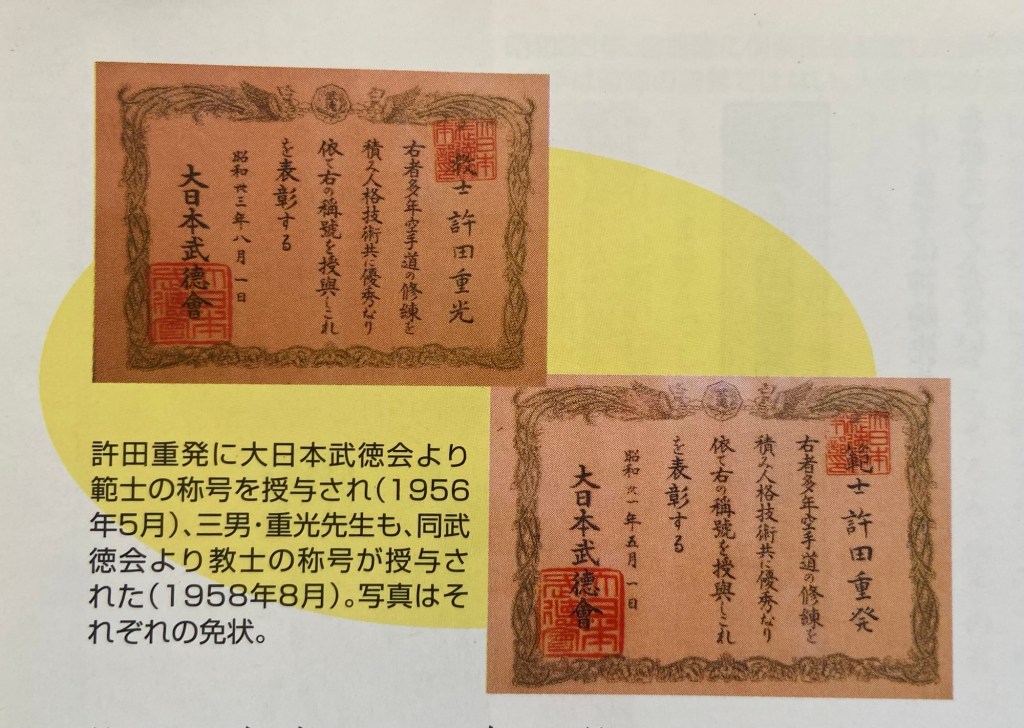
The DNBK Certificate for Kyoda sensei and his son (Jūkō)

Many karateka were already awarded titles by the DNBK before und during the war, including Miyagi Chōjun (Kyōshi) and Mabuni Kenwa (Renshi), among many other masters.

Kyōda sensei and his son, Kyōda Jūkō sensei, on the other hand, were only honored with titles by the newly founded postwar DNBK: Kyōda sensei, who began his training in 1902 under Higaonna Kanryō sensei, was awarded the title of Hanshi after 54 years of training. Two years later, his son Jūkō sensei received the title of Kyōshi.

Translation:

Hanshi – Kyoda Jūhatsu

This person has devoted many years to the practice of Karate-dō and has demonstrated excellence in both character and technique. Therefore, this title is hereby conferred, and this recognition is given.

May 1, Shōwa 31 (1956)

Dai Nippon Butokukai

——————

Kyōshi – Kyoda Jūkō

This person has devoted many years to the practice of Karate-dō and has demonstrated excellence in both character and technique. Therefore, this title is hereby conferred, and this recognition is given.

August 1, Shōwa 33 (1958)

Dai Nippon Butokukai

Kodokan, Kodokan or Kodokan

As many of you likely know, different pronunciations can correspond to different kanji, but the same pronunciation can also be written with different kanji—and thus carry different meanings. A good example of this is the word Kōdōkan.


Kōdōkan 講道館 – Jūdō Headquarter in Tōkyō

Meaning: “Hall for the Instruction of the Way”

  • 講 (kō): lecture, instruction
  • 道 (dō): way (in the sense of an ethical, philosophical, or martial path)
  • 館 (kan): hall, building
    → A hall or institution where the „Way“ is transmitted through teaching and lectures.

Kōdōkan 興道館 – Nagamine Shōshin Dōjō in Naha (Okinawa)

Meaning: “Hall for the Advancement of the Way”

  • 興 (kō): promotion, revitalization, rise, stimulation
  • 道 (dō): way
  • 館 (kan): hall
    → A hall for the revival or promotion of the Way – which, in the context of Matsubayashi-ryū, can be understood as a reference to the renewal or preservation of traditional martial values. The character derives from the names Matsumora saku and Iha tatsu.

Kōdōkan 光道館 – Matayoshi Shinpō Dōjō in Naha (Okinawa)

Meaning: “Hall of the Way of Light”

  • 光 (kō): light, radiance
  • 道 (dō): way
  • 館 (kan): hall
    → A hall of the light-filled path – symbolically representing an “enlightened” or “clear” path. The character comes from the name of Matayoshi Shin.

Tō’on-ryū in Japanese & Western Literature / My future Tō’on-ryū article

I believe it is no longer much of a secret that I am currently working on an article about Tō’on-ryū. I would like to share a bit of my ongoing research with you. I believe this step is both right and important.

It should also come as no surprise that I strongly prefer to work almost exclusively with Japanese sources – though I do occasionally draw on English-language materials as well. This was, of course, also the case with Tō’on-ryū.

It should be noted, however, that even in Japan, very little has been written about Tō’on-ryū – and when it has, the books are usually only available through secondhand bookshops.

Two of the most important students of Kyoda Jūhatsu wrote down their recollections, in which they sometimes provided detailed accounts of Kyoda – most notably Iraha Chōkō (1968, 1981a, 1981b) and Kanzaki Shigekazu (1999, 2003a, 2003b).

However, Murakami Katsumi and Ōnishi Eizō also wrote extensively about Kyoda in their books – Murakami was even the first to gain deeper insight through several conversations with Kyoda. But Ōnishi should not be overlooked either – he must be considered a pioneer, as he traveled to Beppu with a letter of recommendation from Tōyama Kanken, opening the door for several karateka.

Iraha Chōkō is widely regarded as Kyoda’s most important student from Okinawa. After Kyoda’s death, he was interviewed several times – among others by Koyama Masashi, who recorded the entire conversation, and by Hokama Tetsuhiro, who interviewed Iraha in 1984 and published his insights both in a book and in an article. Murakami Katsumi also had the good fortune to meet Iraha and compare his own techniques learned under Kyoda with Iraha’s.

Tokashiki Iken also made an important contribution. Although he never met Kyoda personally, he spoke with several individuals who had been close to him – including Kanzaki Shigekazu (3rd sōke of Tō’on-ryū), Kyoda Jūchoku (second son of Kyoda Jūhatsu), Shimabukuro Katsuyuki (Kyoda’s grandnephew), and Kojō Kafu (a student at the school where Kyoda taught).

These are among the most important works written in Japanese about Tō’on-ryū and Kyoda, and they have naturally all been incorporated into my article.

During an earlier conversation, a German karate researcher advised me to also include English-language sources, as they sometimes address important questions that Japanese authors often neglect.

I took this advice to heart and analyzed many English-language sources, comparing them with the Japanese ones. I came to the conclusion that many of the early English-language writings on Tō’on-ryū and Kyoda sensei are largely copies of texts by Hokama Tetsuhiro and Murakami Katsumi.

The first major Western research was carried out by Mario McKenna, who became the first Westerner to study Tō’on-ryū under Kanzaki sensei – and indeed the first to conduct an interview with a karateka from the Tō’on-ryū tradition. Naturally, McKenna also drew on the Western sources I mentioned earlier, comparing them with the Japanese materials and asking Kanzaki sensei in-depth questions based on this comparative research to advance his work further.

In addition to the two interviews McKenna published at the time, he also spoke with many other significant individuals who made important contributions to his Tō’on-ryū research. I would be very happy to read his full body of work once it is published.

All of these written sources were carefully reviewed and compared by my wife and me, and were supplemented by interviews with experts as well as with previously unpublished materials. I look forward to being able to publish my research findings soon.

Honored and Inspired by a Reader’s Words

Since I began publishing my research in Gekkan Hiden magazine — with heartfelt thanks at this point to Koyama sensei for connecting me with the publisher — an increasing number of reader letters have been printed. I would like to briefly introduce one of these short letters below.

To think that Inoue Kishō sensei of Ryūkyū Kobujutsu is the great-grandson of Inoue Katsunosuke—what an incredible lineage. I heard that he demonstrated nunchaku-jutsu at this year’s Kobudō demonstration. I really wish I could have seen it live. Next time, I will definitely make my way to the Nippon Budōkan. – (Ibaraki Prefecture / F.S. / 49 years old)

I am aware that I am still a relatively unknown and fairly young researcher — but words like these bring me joy every time and motivate me to continue working diligently and to further deepen my research.