Review – The Origin of the Kata Jion

Wow—Motobu Naoki Sensei has already reviewed my second article. After reviewing my first article on Yabu Kentsū (Gekkan Hiden 7/2024), this time he discussed my article of the Jion Kata.

The review can be found on both Patreon and Medium. Additionally, there is a Japanese review on Motobu Sensei’s Note blog.

Thank you very much for featuring my article and for the kind words—it made me very happy.

Both the Yabu article and the Jion article will be translated into English and will be published next year as part of a book containing many other informative articles.

NEW – Interview Series with Karate Masters from Okinawa

I would like to draw your attention to a small update. I am proud to announce the beginning of our interview series with Okinawan Karate masters.

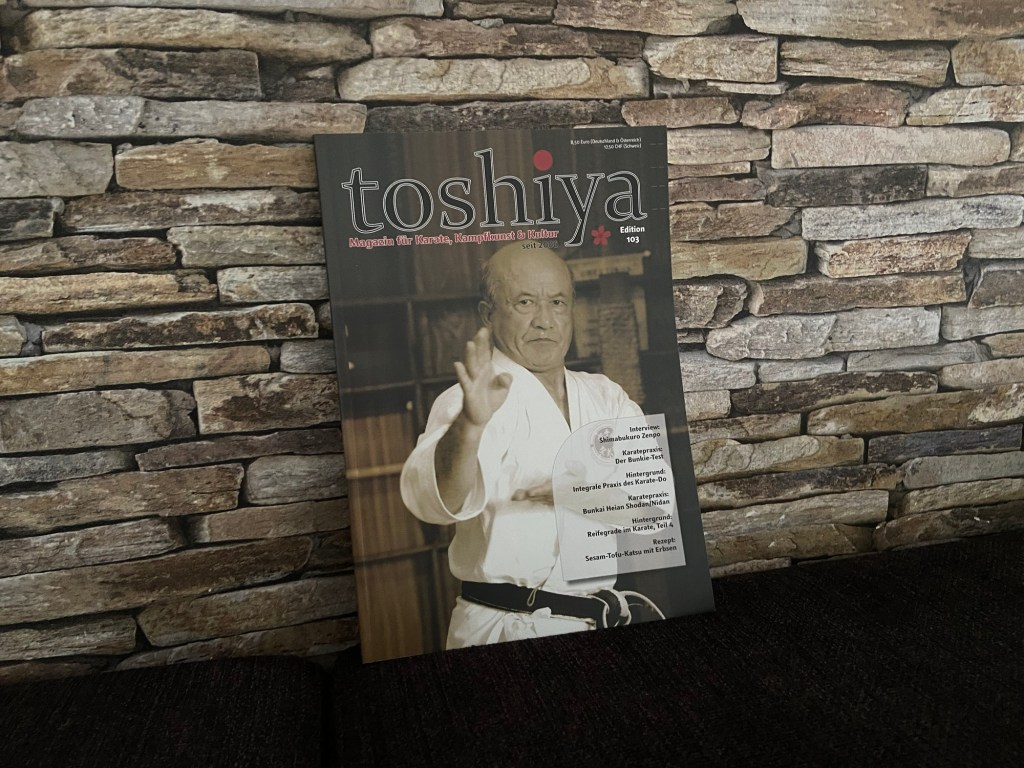
Toshiya, No. 103

In Toshiya Issue No. 103, our very first interview with Shimabukuro Zenpo Sensei (10th Dan Shōrin-ryū Seibukan) has been published. In addition to 40 questions for Shimabukuro Sensei, the interview also includes 10 questions for the German representative of Shōrin-ryū Seibukan, Jamal Measara Sensei (9th Dan Shōrin-ryū Seibukan).

My wife and I conducted these interviews during our last trip to Japan, which was more of a research trip—no, not just three days, but almost the entire journey. During this time, we had the opportunity to conduct several interviews, which will also be published in upcoming issues of Toshiya. They may not appear consecutively, as there will be a rotation, and other interviews with German Karateka, not conducted by us, will also be featured.

So, it might be a good idea to subscribe… there are still many interesting interviews to come.

And if anyone would like to have an interview conducted with their Sensei, feel free to contact us… we will try to make that interview happen as well.

Why do I publish in a Japanese medium?

I was once asked by a German writer why I publish in a Japanese medium, and at the same time, I was told that no one reads it anyway. This was before my first article had even been published (December 2023).

The answer is actually quite simple: for the same reason that I travel to Japan to explore the culture and decipher parts of Karate history in order to preserve them for future generations.

In the meantime, we are about to publish our third article, and the response we have received in Japanese circles has been overwhelming. We also gifted magazines to our interview partners, and the feedback was very positive there as well—the Gekkan Hiden magazine is indeed read in Japan and has been in publication since 1993.

For this reason, we will continue to work intensively with Gekkan Hiden, and we have already submitted two more articles that will be published in mid-October and mid-December. These articles will very likely be read in other countries as well.

How to support a fellow researcher

There are different types of karate historians. There are some who mostly work from home, many who buy their own sources, and then there are those like Andreas Quast, who has spent countless hours, if not days, in archives and various libraries. In this way, he was able to build up a comprehensive, small private archive from which he can still draw today.

Over the years, he has published many books, articles, etc., and is always helpful, leaving behind a clear trail that one can follow to continue working on his research in the future.

We can say THANK YOU or support him by purchasing his books, something I have been doing since 2007.

Or we can follow him on Patreon and support him in his further research projects – which are definitely worth supporting.

Yabu Kentsu & Miyagi Hisateru

Miyagi Hisateru’s reflections on Yabu Kentsū reveal a deep reverence for his sensei, who was not only a prominent figure in Okinawan karate but also a respected military leader. Miyagi’s accounts of their time together at the Okinawa Normal School and his unexpected reunion with Yabu in Hawaii in 1927 highlight the lasting impact Yabu had on both his martial arts students and his military peers.

Our article series !!!

As I wrote before, my wife and I are working on an article series about Okinawan Karate. Actually, we are working on two series, but that is something for the future. For now, let’s focus on the first planned series.

In my first article, I introduced a “rare” obituary written by Hanashiro Chōmo for his friend Yabu Kentsū. In my second article, I delve deeply into the Kata Jion, which is, for me, a very important Kata for understanding the Karate of Yabu Kentsū more deeply. We could even call it the “key” Kata. However, according to Yabu’s teaching method, it should probably be placed between Naihanchi and Gojūshiho.

Can anyone guess what the third article will cover?

Yabu – The Untold Journey of an Okinawan Man

I just want to say two things about this book. Firstly, the book is well-researched to some extent.

My copy, privately bought

However, I need to clarify a few things about Yabu’s Gojūshiho:

  • Firstly, the Gojūshiho of Nakazato Shūgorō sensei is not from Yabu Kentsū sensei. Nakazato himself confirmed in a Japanese interview that all his kata came from Chibana Chōshin sensei, except for Gojūshiho, which comes from the Hanashiro Chōmo lineage.
  • Secondly, the only student of Chibana sensei who received “Yabu no Gojūshiho” is Miyahira Katsuya, who got the kata via Tokuda Anbun 徳田安文 (1886-1945). Tokuda himself was a student of Yabu Kentsū at the Shihan Gakkō (mentioned by Yamauchi & Nakayoshi).

It also needs to be mentioned that the life dates given by Feldmann for Tokuda Anbun sensei are not correct. (see Page 325)

Motonaga Tomohiro – The Understanding of Chinkuchi

For the first time, this significant karate text is presented with accurate translation. It describes the words of Kyan Chōtoku’s grandson and allows him to talk about Chinkuchi. The article was also introduced and discussed afterward—enjoy reading it!