Happy Christmas season

The year is slowly coming to an end. I would therefore like to wish all my fellow karateka a reflective Advent season, a Merry Christmas, and later a Happy New Year for 2025.

Created with ChatGPT

We have concluded the year with a total of four articles in Gekkan Hiden magazine (the latest one also in English & Portuguese), and the fifth article is already scheduled for publication on January 14, 2025. I hope that 2025 will be just as exciting and interesting as 2024.

I look forward to sharing more about our plans for 2025 at the end of January.

The Monument of Kyan Chotoku

The monument, erected under the leadership of Nakazato Jōen in 1999, honors the legendary Karate master Kyan Chōtoku. Situated near the Hija River, it marks the area where Nakazato trained under Kyan from 1937 to 1943, before leaving for the Pacific War. Having visited this site in January 2024, I feel it is now the right time to share my translation of the monument’s inscription, which celebrates Kyan’s profound legacy in Okinawan Karate.

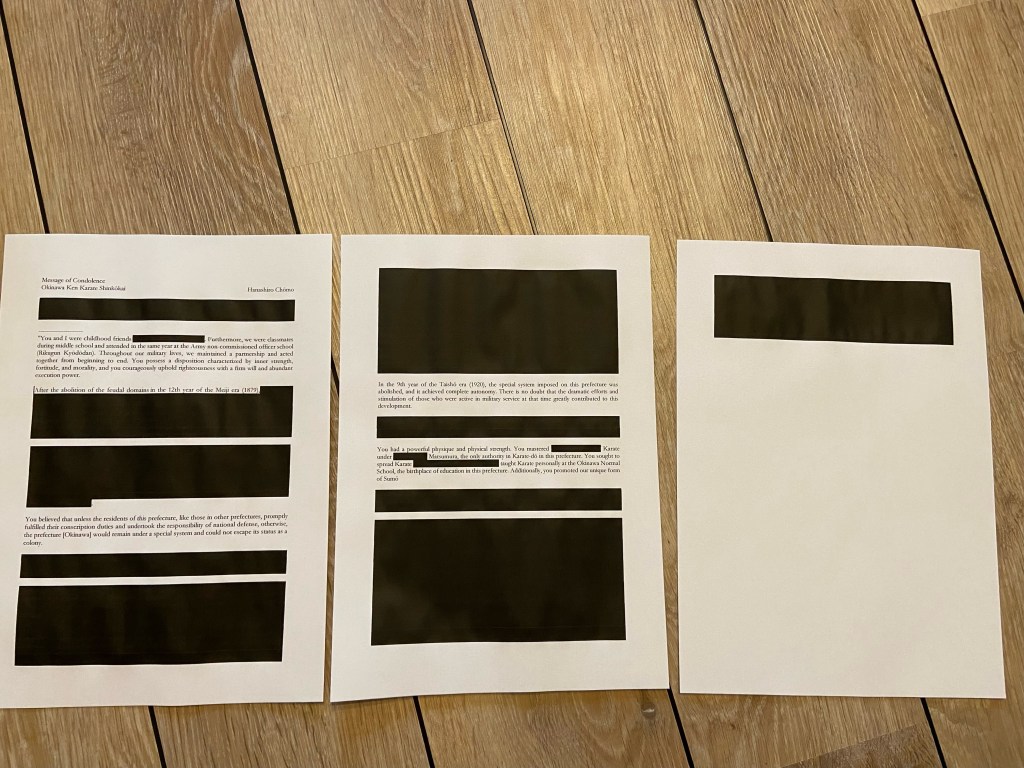
Hanashiro’s Obituary for Yabu Kentsû

Currently, there are two translations of Hanashiro’s words into English. Comparing both texts reveals significant differences—not only in the style of translation. Hanashiro addressed his obituary to the heroic spirit of Yabu Kentsû.

However, there are substantial discrepancies in the actual text. In my translation, I blacked out the sentences missing in the other translation to give an idea of how much was actually omitted.

Yabu Kentsu – The Cat and the Tiger

During my recent stay in Okinawa, I observed the Ryū’ei-ryū training led by Sakumoto sensei, which reminded me of stories about Yabu Kentsū’s karate. Yabu emphasized a balance of gentleness (lamb), agility (cat), and strength (tiger) in his teachings.

Thank you …

It is impossible to write a well-founded article without following in the footsteps of other authors who have already written on the topic, trying to gain new insights and then connecting these with previous knowledge. That is exactly what I did with my latest article.

First and foremost, I would like to express my gratitude to the late Kinjô Hiroshi sensei and the late Yamauchi Seihin sensei, who wrote an article back in 1956, also discussing the figure of Yabiku Môtoku sensei, a person who is now relatively unknown even on Okinawa.

Further thanks goes to Chinen Yudi sensei (the grandson of Kokuba Seitoku), who shared the video of the 1951 demonstration on his YouTube channel in 2016. It was Motobu Naoki sensei who revisited the report by Kinjô Hiroshi sensei and Yamauchi Seihin sensei and connected it to the video published in 2016, documenting the demonstration. He was also able to establish contact with Yabiku Marcelo at that time.

I also owe a special thank you to Yabiku Marcelo, the great-grandson of Yabiku Môtoku sensei, who has always been willing to answer my numerous questions, sent me a copy of the demonstration, and provided me with 14 photos for my research.

The almost exclusive credit for the research in Hawai’i goes to Charles Goodin, who, as far as I know, spent countless hours in libraries, sifting through endless newspapers. Even more importantly, he spoke with the children of the demonstrators from that time and was able to gain significant insights. I discovered an error in one of the newspapers, which I corrected to create a clearer picture. I also extend my gratitude to the staff at the Hawaii Karate Museum, who allowed me to use four photos that Mr. Goodin had found, which are currently housed at the University of Hawaii.

From my newspaper research in Germany on German Jiu-Jitsu, I’ve learned that with enough searching, you can almost always find a program, report, or something similar for a demonstration. In this case, I was also able to find a program of the 1951 demonstration in São Paulo, which my wife and I translated after many hours of character search.

A special thanks goes to the BAB (Gekkan Hiden) publishing house, which allows us to publish our research findings. For this article, we took on the challenge of translating it into English and also publishing it in Portuguese for the first time. A huge thank you to Thomas Krekel for proofreading the English version, and an even greater thank you to Lucas Barboza for the wonderful Portuguese translation.

Thank you so much.

Without all the help, this article would not have turned out as well as it did.

I wish I could have expressed my gratitude to everyone directly in the article, but we were limited to just 6 pages in the magazine, even though we could have easily written 15. So, the only option left was to dedicate a few lines on my blog.

Yabu sensei’s correct depature from Hawaii

An in-depth exploration of the karate history of Yabu Kentsū necessitates working with Japanese primary sources and analyzing them in great detail. Only in this way can discrepancies be uncovered and corrected, even if they pertain to seemingly minor details. Otherwise, there is a risk that errors will be perpetuated or false information will be regarded as truth, which can significantly undermine historical accuracy.

Was Baron Münchhausen a Karateka?

I recently had a conversation with a friend about a topic that led us to notice something curious: some Western karateka tend to exaggerate their own karate history, a phenomenon that’s not entirely new. Unfortunately, we encounter this behavior occasionally even among so-called karate historians, who claim to have conducted extensive interviews with certain masters.

Baron Münchhausen as a karateka (Created with ChatGPT)

I also recently found that research trips to Okinawa are sometimes inflated as well. A journey that involved merely six days of research was stretched into nearly a month. The reasons for this remain somewhat unclear to me… Is it an effort to cultivate an aura of expertise, or perhaps a way to appear more professional?

In the past, people often claimed to have obtained information from a particular master, most of whom, unfortunately, have since passed away, making it impossible to verify these claims. But now, it seems these „Münchhausens“ are not even afraid to use this tactic with living masters. Oh yes, there are people who ask questions, and the answers they receive often differ greatly from the stories told by our „Münchhausens.“

Thank you Ikeda sensei

I would like to express my heartfelt thanks to Ikeda Jūshū 池田重秀, the 4th Sōke of Tō’on-ryū. Without karate training, it is almost impossible to write an academic paper on a karate figure, a karate kata, or even a karate anecdote. In this process, it is not only important to consult written works but also to speak with karateka within a karate lineage. Without taking these steps, the expected research results cannot be achieved.

Tō‘on-ryū Karate-dō – Beppu Honbu [Dōjō] – August 23, 2024

The Jion kata was already my favorite kata during my Shōtōkan days, and I still focus on it. This led to the decision that Ikeda Sensei showed me „Yabu no Jion,“ even though this kata was planned for a later visit. Since I was already familiar with a version of Jion, I was able to quickly adapt Yabus version of Jion – of course, there are still many things that need Ikeda Sensei’s corrections.

I am deeply grateful to Ikeda Sensei for teaching me „Yabu no Jion“ and for allowing us to include two photos with him in the article. A special thanks also goes to my wife, who took the fantastic pictures.

A small note about the photos: we chose identical movements that were also performed by Funakoshi Gichin (1925) and Hanashiro Chōmo (1938).

Ikeda senseis words are as follows:
Yannick, a member of Tō’on-ryū, published his research findings on Jion in [Gekkan] Hiden. I consider the research content to be excellent.