Intended Meaning

In linguistics and translation studies, Intended Meaning refers to the intended significance of an expression or text, that is, what an author or speaker actually wants to convey, independent of the words chosen. It concerns the underlying intention, which can often only be discerned through context, cultural knowledge, and historical background.

SL = Source Language; TL = Target Language

Example: The sentence “He’s seeing stars” could literally suggest that he is observing stars in the sky, but the intended meaning is actually “He is dizzy or injured.” In translation, this concept is particularly important: Erwin Koschmieder (1896-1977) referred to it as das Gemeinte (the intended meaning), which also functions as a tertium comparationis – a theoretical “common denominator” connecting the source and target languages.

Understanding the intended meaning requires not only linguistic competence but also cultural, historical, and situational knowledge, since many meanings are implicit, symbolic, or philosophically coded. This is especially crucial for specialized texts, literary works, or culturally embedded content (e.g., Okinawa Karate), where grasping the intended meaning is essential to convey the sense accurately.

Historical Karate Research and the Art of Waiting

Engaging with the history of karate is often like embarking on a long journey filled with detours, quiet moments, and unexpected encounters. Those who dedicate themselves to historical karate research soon realize: it is not only about dates, names, and techniques, but also about patience – a virtue practiced both in the dōjō and at the desk.

The Incompleteness of Sources

Karate was born in a time when written records were scarce. Much was passed down orally, some deliberately concealed. Today we find fragments: old photographs, handwritten notes, the memories of students. These fragments gradually form a picture, though gaps always remain. Researchers cannot expect quick answers here.

The Parallel to Practice

In training we learn: progress does not come overnight. A kata often accompanies us for decades, revealing its depth only with patience. The same applies to historical sources. A document can lie unnoticed in an archive for years until, at the right moment, it is discovered – sometimes by chance, sometimes through persistent effort.

The Art of Waiting

“Sometimes things come to us without us expecting them.” This phrase captures both the spiritual attitude within karate and the research process itself. Those who wait without forcing the search open themselves to the unexpected. It is often precisely these chance finds, encounters with other researchers, or hints from unforeseen directions that offer decisive new perspectives.

Research as „dō“

Just as karate is a “Way” (dō), historical research can also be understood as a path. It is a process requiring patience, dedication, and a willingness to embrace not-knowing. Walking this path reveals that knowledge lies not only in the result, but also in the inner attitude with which we seek – and wait.

Yabu and Hanashiro at War

In my last two articles, I first presented the obituary that Hanashiro Chōmo wrote for his friend Yabu Kentsū, followed by a letter that Yabu composed shortly before his deployment to war, addressed to his former school principal. Both documents make reference to the First Sino-Japanese War (1894–1895), with Yabu’s letter written on the eve of his departure to the front. From Hanashiro’s words, further valuable details can also be gleaned, as he specifies the exact battalion to which they belonged. As I noted in the previous article, Yabu set foot on Chinese soil for the first time on January 23, 1895.

Even greater insight can now be gained from an official report written by Yabu’s regiment: although Yabu and Hanashiro are not mentioned by name, the knowledge of their battalion allows us to clearly establish the context. Finally, it is worth noting that even the roughly 60 kilometers traversed by the Japanese army at that time were preserved in musical form.

It should be noted, however, that only the music is connected; the film scenes, on the other hand, depict another dreadful event which has already been filmed twice.

Yabu’s Letter to His Former Principal

Yabu wrote this letter shortly before his first and only deployment in the First Sino-Japanese War. One can sense in Yabu’s words that he was eagerly awaiting the opportunity to experience his first combat mission. It should be noted that the Japanese military had already won several battles before Yabu joined the campaign.

As mentioned earlier, only Hanashiro’s account provides information about the exact company and battalion in which Yabu served. Therefore, I have restored the previously obscured parts of the letter to learn more about his actual military engagement. This restored information will also be referenced in future articles and writings.

Several days passed after the letter before Yabu set foot on Chinese soil for the first time on January 23, 1895.

Update – Yabu Kentsu

Hi everyone,

my article about the obituary of Yabu Kentsu has been online since last Thursday/Friday.

As of today, the article has been downloaded 75 times and was even purchased once afterwards – a very heartfelt gesture that made me truly, truly happy.

How did you like the article?

Did any questions come up?

Were you surprised or even shocked?

And there’s more good news:

Over the next two Fridays, another article about Yabu Kentsu will be published each time – so stay tuned!

Yabu Kentsu Remembered: A Portrait by a Close Companion

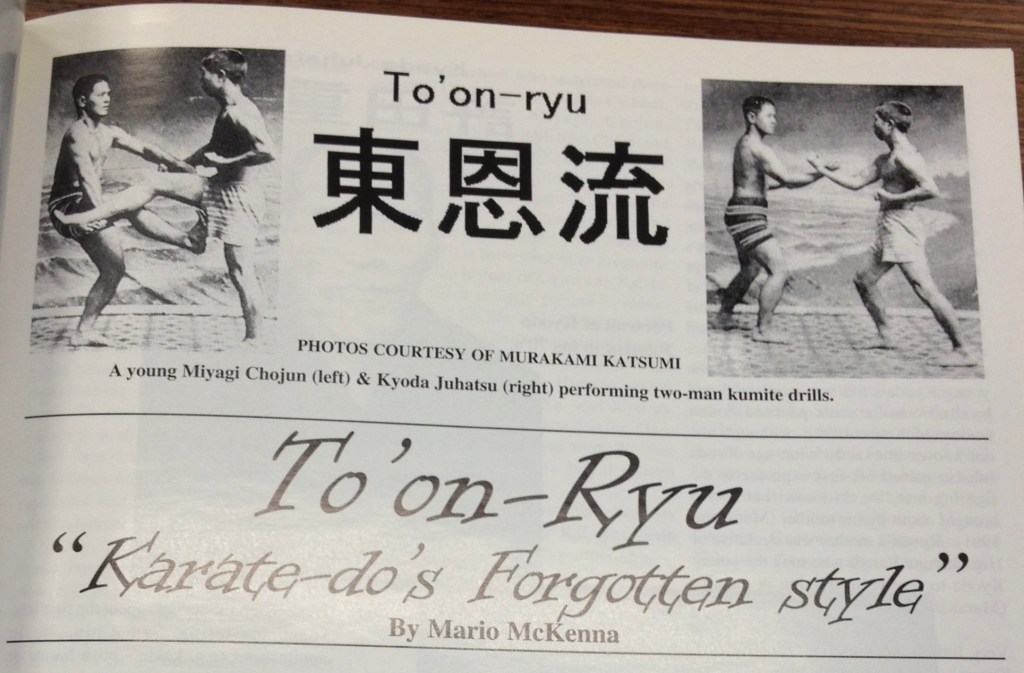
I am currently devoting more time again to studying the soldier and karateka Yabu Kentsū. Alongside Higaonna Kanryō, Higaonna Kan’yū, and Go Kenki, he was one of the four teachers of Kyoda Jūhatsu, although it should be noted that Kanryō played the longest role in Kyoda’s training.

In recent years, I have tried to read many of the texts written about Yabu in their original form (Japanese). Of particular note is the work of Yabu’s friend Hanashiro Chōmo. My wife and I once took on the painstaking task of translating Hanashiro’s text as accurately as possible while preserving his writing style. We later succeeded in publishing the text in English as well – until now, however, it was only available for purchase on my Patreon page. I have now decided to make the text freely available, as I consider it very important to provide a complete translation and give subsequent generations of karateka the opportunity to learn more about Yabu.

This obituary – alongside the two-part newspaper article from March 18 and 19, 1932 – is of great importance. The first part has already been translated into English, whereas the article from March 19 has not yet been referenced in any English sources. To better understand Yabu’s mindset and his role as a soldier, both articles are highly recommended. The complete 1932 newspaper article has already been translated and will be published at a later date.

It should also be noted that in the obituary, Hanashiro specifically addresses Yabu’s military service in the First Sino-Japanese War (1894–1895). Hanashiro describes this as an eyewitness, not as someone who merely heard the stories secondhand. Hanashiro’s statements also allow for deeper research regarding the Sino-Japanese War—since he breaks down Yabu’s service from division level down to company level, making it possible to reconstruct the exact course of the war.

Please read, share, and recommend. Anyone interested can still purchase the article on my Patreon page and thereby leave me a small donation.

20% Work, 80% Result: The Pareto Principle

Left (Input): 20% of the work vs. 80% of the work.

Right (Output): That small 20% produces 80% of the result, while the other 80% of the work leads to only 20% of the outcome.

Doing 80% of the work for only 20% of the insight can seem very daunting, partly due to limited time and resources… but sometimes all it takes is finding the right key.

What makes Koyama sensei’s Miyagi Chōjun series so special?

Koyama traveled to Okinawa for a thesis project at Kyoto University—back in 1977—and the focus of his trip was the founder of Gōjū-ryū Karate-dō. As a small side note: around 1977, there were hardly any books or writings on Miyagi or Gōjū-ryū for comparison.

Books by Uechi Kan‘ei (1977), Miyazato Ei‘ichi (1978) and Nagamine Shōshin (1975)

This was one year before Okinawa-den Gōjū-ryū Karate-dō (1978) by Miyazato Ei’ichi sensei was published, two years after the 1975 book by Nagamine Shōshin appeared, and in the same year as the book by Uechi Kan‘ei.

It was, therefore, an early pioneering work in Gōjū-ryū research and on Miyagi Chōjun.

Although Koyama sensei is not an Okinawan, that is actually an advantage—namely, his neutrality. He was able to do something that Okinawans affiliated with a dōjō could not: he could speak with every karateka who had personally known Miyagi—and that is exactly what Koyama did.

He spoke not only with Miyagi’s students, but also with family members, such as Miyagi sensei’s second daughter and fourth son.

The series therefore describes Miyagi’s life in considerable detail. Naturally, research has progressed in the years since; new findings have been made and rare documents discovered that were not available to Koyama at the time. Footnotes will be added for these, carefully adapted and included after consultation.

So there is still more to look forward to.

My Miyagi Chōjun – by Koyama Masashi – First English Translation

Koyama Masashi sensei has been a well-known figure in Gōjū-ryū research in Japan for many years.

My Miyagi Chōjun series

Internationally, he became particularly known through the book Karate – Its History and Practice, which he co-authored with Kadekaru Tōru and Wada Kōji.

Starting as early as 1980, Koyama published a 15-part series about Miyagi Chōjun (plus an additional article about his trip to Shanghai). In addition, many other contributions appeared, including an article about Higaonna Kanryō and an interview with the famous researcher of Chinese martial arts, Matsuda Ryūchi.

Incidentally, he demonstrated the kata Saifā in the famous series Nihon Budō Taikei.

But next to his excellent research, he was also a world champion in kata, and was de-throned by Sakumoto Tsuguo (Ryū‘ei-ryū).

My wife and I are fortunate that Koyama sensei has given us permission to translate his earlier series into English. At first, however, it will be a limited edition. If anyone is interested, please feel free to contact me. The text has been fully typed up and is waiting to be translated—may the translation begin !!!

After much consideration, I would like to publish the book in perfect quality, as a hardcover edition with a ribbon marker and other fine details.

Behind the Scenes: How We Prepare for Our Interviews

I was recently asked how we prepare for our interviews.

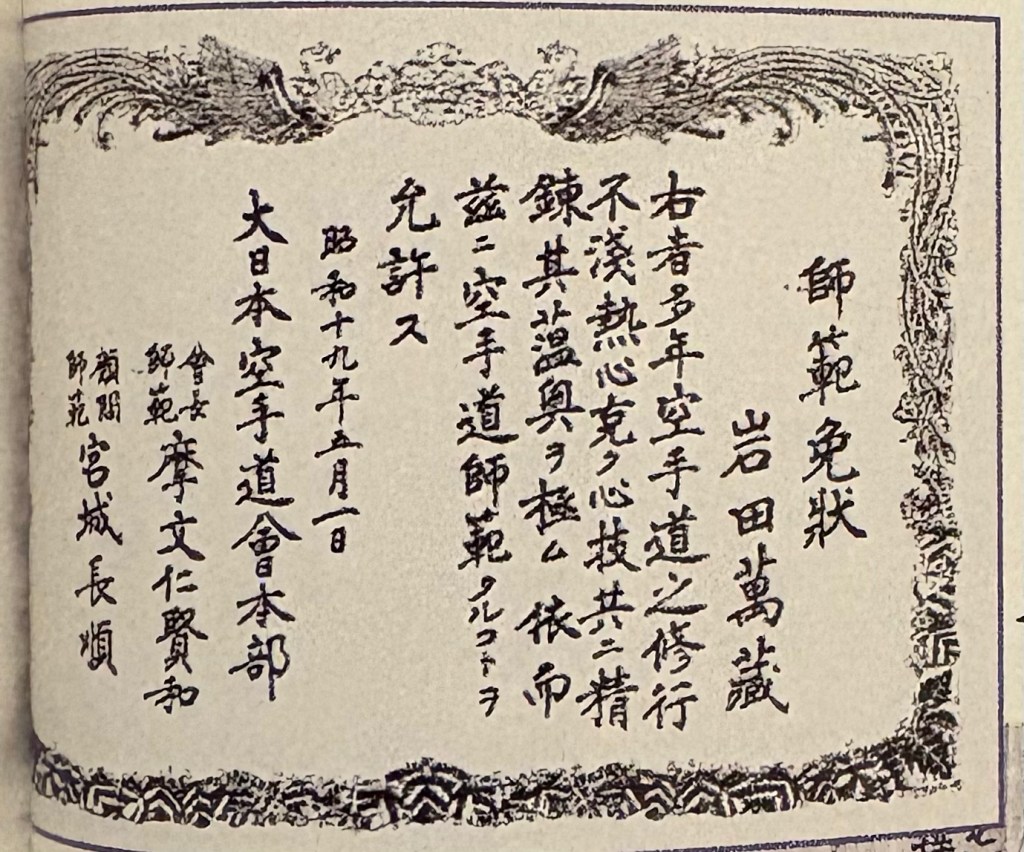
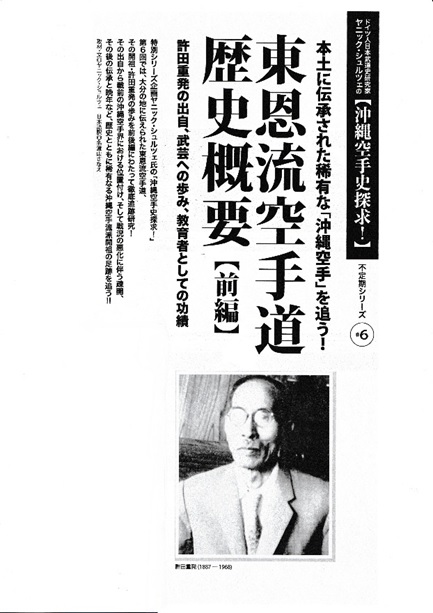
A few sources (japanese only)

The answer, of course, is through reading. This means researching sources in advance, examining and translating them, and then formulating questions based on that research. These questions usually arise from points that emerged during the investigation but were not clearly explained in the sources — areas where I seek more detailed information.

Our next interview to be published will be our conversation with Higa Kiyohiko Sensei.

Interview – Headline

In this case, our main focus was on the karate of Hanashiro Chōmo, as well as Yamanni-ryū, which is also preserved at the Bugeikan.