

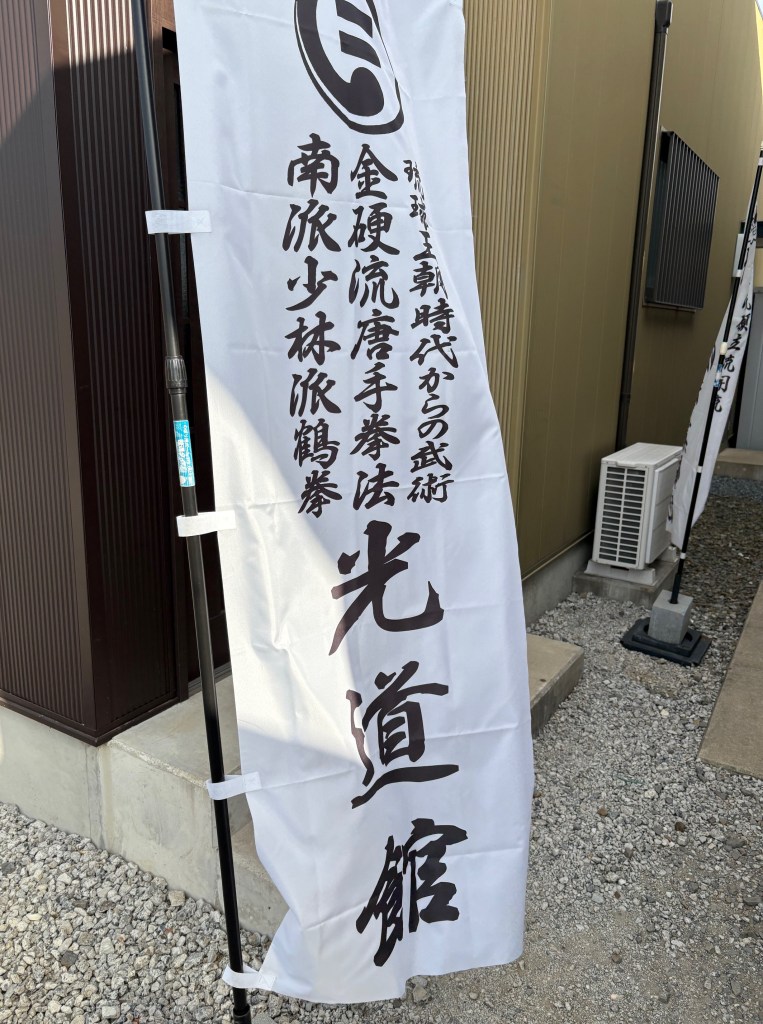
Immediately after the demonstration at the Nihon Budōkan, I returned to my hotel to collect my luggage and then traveled directly to Ryūgasaki, located about an hour and a half north of Tōkyō. I had already seen Hayasaka Yoshifumi earlier at the Budōkan. Unlike the previous year, he did not give a demonstration in Matayoshi Kobudō this time, but instead presented a performance in Negishi-ryū, a shuriken school he inherited from Saitō Satoshi.
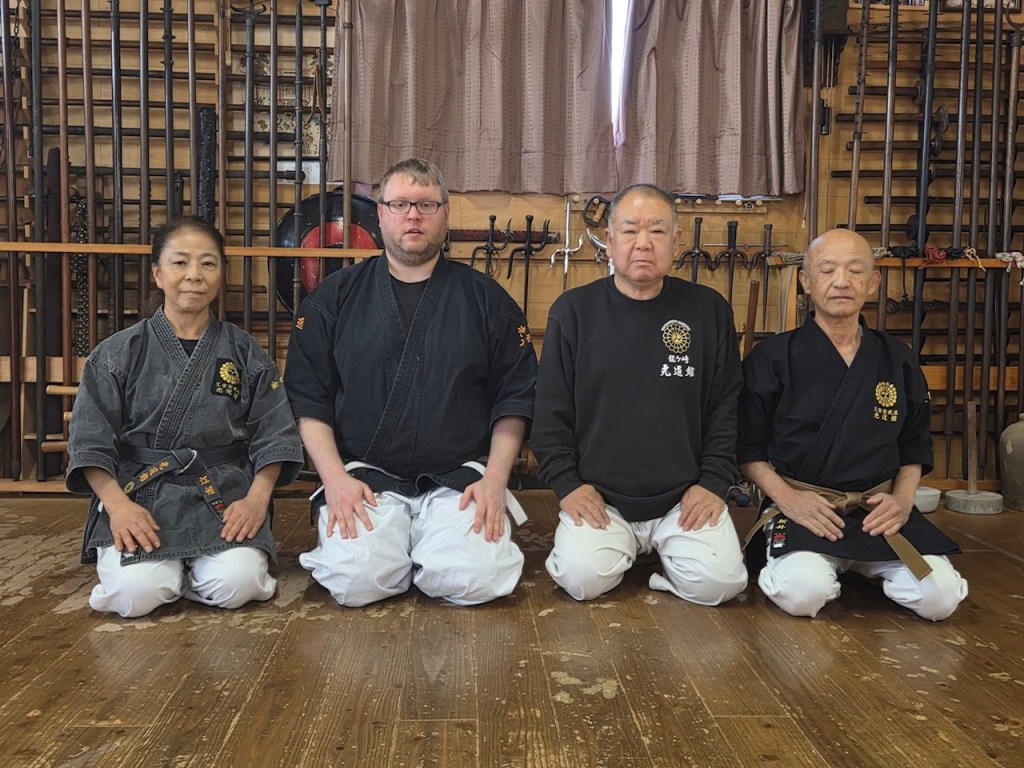
In Ryūgasaki, however, my focus once again lay entirely on Matayoshi Kobudō. Hayasaka instructed me once more in the kata Sōchin and introduced me to many other kata for the first time. He selected a few kata that he felt would guide me in my future training as well as in my research. In the field of kobudō, the training program again included the kata Shūshi no Kon, Nichō Sai, Sanchō Sai, and Chōun no Kon. In the field of Nanpa Shōrin-ha Tsuru Ken, the main focus was on the kata Pāpūren (Tsuru Sanchin), Kakufā, and Tan-kaku, as preparation for more advanced kata in the following years.
Hayasaka studied directly under Matayoshi Shinpō. Unlike many of Matayoshi Shinpō’s other students, however, he never lived on Okinawa, but instead traveled from mainland Japan to Okinawa during the summer months to study under Matayoshi. In this way, one might say that he built a connection—a bridge—to Okinawa at that time, a connection he continues to maintain to this day. He is currently the highest-ranking active student of Matayoshi Shinpō and remains affiliated with the Kōdōkan in Naha.
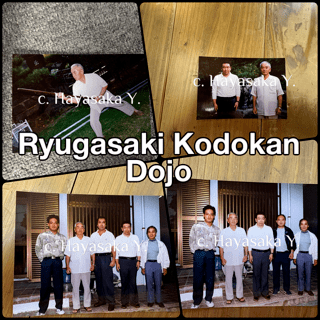
The image was deliberately uploaded with a watermark and intentionally in low quality. The images are the property of Hayasaka Yoshifumi, and he has granted me permission to upload them only under these conditions. I ask all karateka to comply with this rule.
During the training sessions, he guided me extensively and also shared many stories—what I would also describe as “bridges”—about his visits to Okinawa and the many families he met together with Matayoshi Shinpō, for example the Chinen family, but also the Soeishi family. He also mentioned a visit and showed me many photographs of his time with Kakazu Mitsuo, who at that time was the last living student of Matayoshi Shinkō. In addition, he told me many stories about Kina Seikō sensei, an almost forgotten pioneer of Gōjū-ryū Karate-dō and a very early student of Miyagi Chōjun. Kina Seikō was also recently mentioned by Nakamura Tetsuji in his new book on Arakaki Shūichi (pp. 107–109).
The kobudō taught by Hayasaka differs in certain respects from what I had learned previously, and the transition still presents challenges for me. The kata themselves are identical, but certain body movements differ from those I had learned before. It feels neither right nor wrong to my body; rather, at times it feels as though I want to perform both versions simultaneously. Instead, my body must gradually adapt and absorb the new movement patterns.
At present, besides myself, only one other foreign student is studying Matayoshi Kobudō under Hayasaka: Angelo from Italy. Thus, the two of us are currently based in Europe. In this way, I am able to build a bridge from Germany to Ryūgasaki, and I am deeply grateful to Hayasaka sensei for accepting me as his student.
Alongside the training sessions at the Ryūgasaki Kōdōkan, I once again had the great fortune to learn much about the history of Matayoshi Kobudō and to consult several valuable books from Hayasaka sensei’s personal collection—a privilege I had already enjoyed the previous year. In closing, I would like to thank him once again for the highly instructive training and express my hope to return as soon as possible.
 Karate Kenkyū Shitsu