Kobudō, Sanseru, and Ramen: A Weekend with Ōshiro Sensei in Düsseldorf

Last weekend, I spent my time in Düsseldorf, the capital of North Rhine-Westphalia.
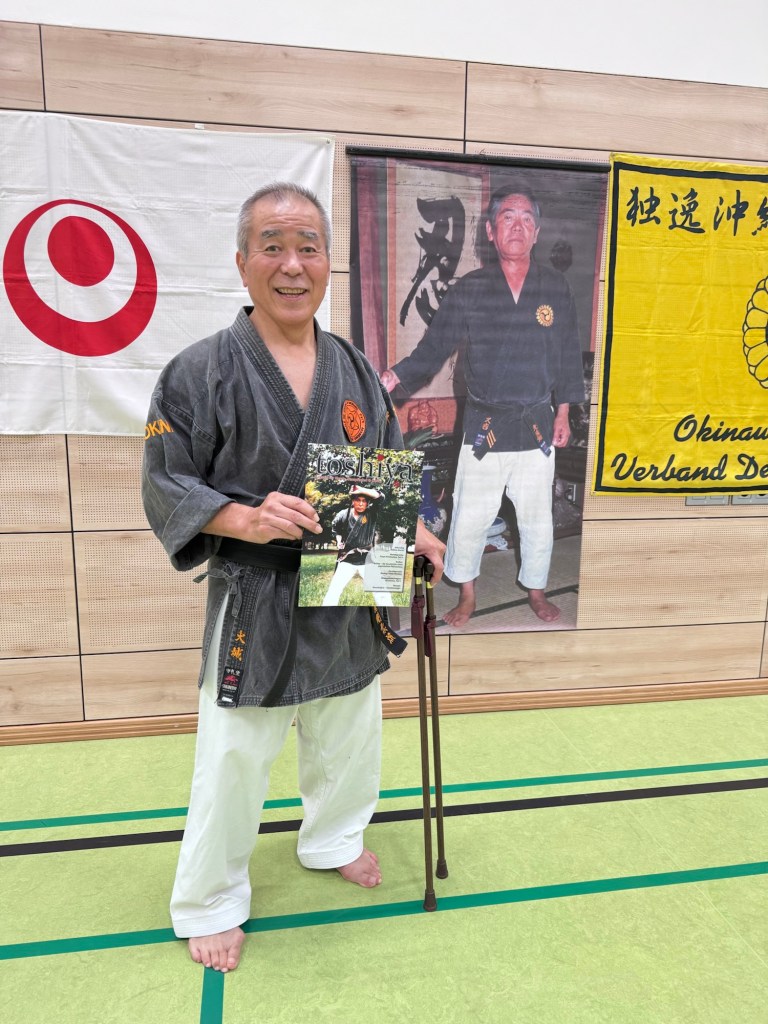
Ōshiro Zen‘ei Sensei

As many already know, we have been publishing our interviews with masters from Okinawa for almost two years. One of these interviews, which we conducted last year and which was published in March of this year, was with Ōshiro Zen’ei Sensei. Ōshiro Sensei lived in Düsseldorf for a period and came into contact with Japanese guests there. One of these Japanese, Hiura Sensei, also discovered Matayoshi Kobudō for himself and founded the Okinawa Kobudo Verband Deutschland e.V. in 1986, which will celebrate its 40th anniversary next year.

Before traveling to Düsseldorf, we spent a few days in Belgium. On Friday, we continued to the Rhine metropolis. After checking in, we first made a detour to our favorite Japanese restaurant to enjoy Japanese cuisine once again … 
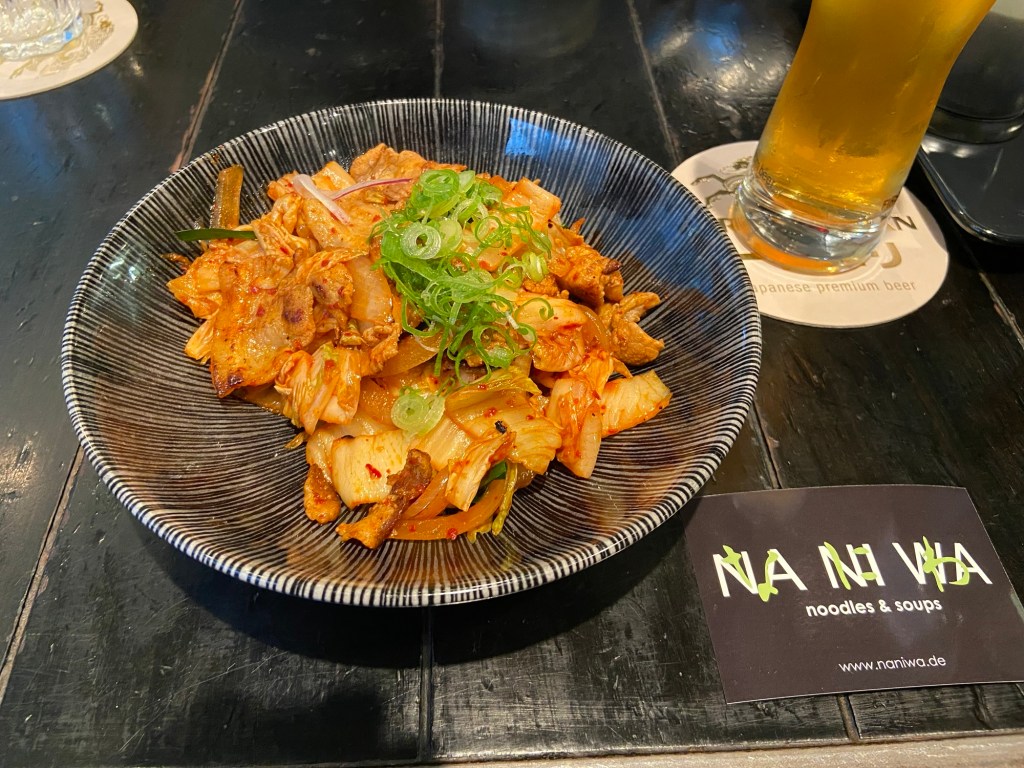
Buta Kimchi
Tantanmen

The seminar with Ōshiro Sensei began on Saturday and lasted for two intensive days. I already knew some of the participants from Pforzheim, while others were new faces. Like almost all Kobudō seminars, this one began with the Bō, including Hojo-Undō Dai Ichi, Ni, and San, before moving on to the two kata developed by Ōshiro Sensei: Kiso Ichi and Kiso Ni – of course, followed by partner exercises.

After a short break, the training continued with Tunkwa. Here, too, we started with Hojo-Undō and partner exercises before practicing the kata Kiso Ichi. As always, the day passed far too quickly.

In the evening, the seminar shifted to the more relaxed part of the weekend: We went to a traditional German restaurant to unwind and enjoy ourselves.

The second day began at 10:00 a.m., and we picked up right where we had left off on Saturday. On the program were Tunkwa Kiso Ichi and the kata Matayoshi no Tunkwa Dai Ichi, followed by training with the Sai, again including Hojo-Undō and kata practice. The last thirty minutes were devoted to the Kama, concluding with the kata “Kama no Tī.”

During the seminar, I took the opportunity to ask Ōshiro Sensei a question about the Sanseru of the Shōdōkan. I also had my author’s copy of Toshiya signed and picked up the second volume of his latest book – I had already had the first volume signed last year in Pforzheim.

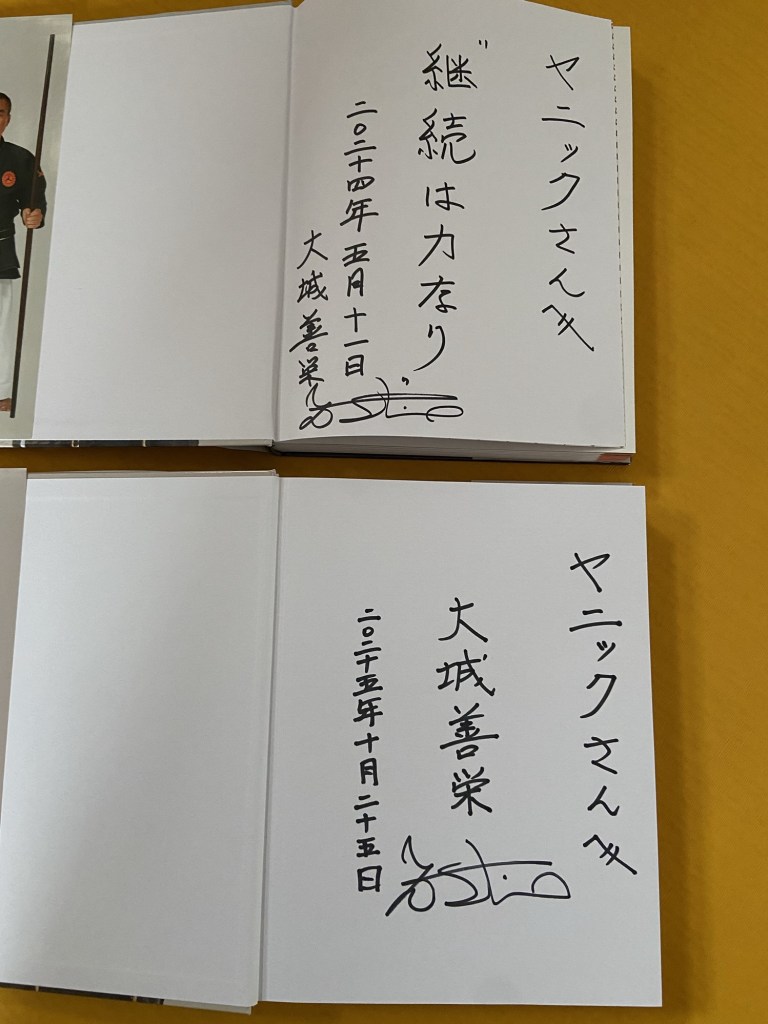
Vol 1 – Bō & Tunkwā / Vol 2 – Sai, Nunchaku, Ekū & Kama
Signed copies

In the coming days, I will write a more detailed report about the Sanseru …

And, as a delightful coincidence, the weekend coincided with “Karate no Hi” in Okinawa – a nice touch that made the experience even more special.

The book about Miyagi Chôjun / Miyagi hated lying !!!

In the past few days, I have been asked several times about the translation of Koyama Sensei’s book on Miyagi Chôjun (1888–1953).

It will still take a few days until the book is finished. The rough translation is already done; now the focus is on carefully proofreading the text. I will go through the first draft, then my wife will check the second draft. After that, we will work on the images, tables, and other materials. Only when everything is perfect will the final editing take place – to ensure that all names are translated consistently – and only then will the index be created.

Here is a small preview: what Miyagi Chôjun thought about lying:

My father hated lying. One time, my sister was playing with her friends and wouldn’t let me join. So I told my sister, “Big sister, father is calling you,” and sent her home. But when I got home, I was scolded hard: “You lied! When did father say to call your sister?” I was severely punished. He said, “If you lie this much now, who knows what kind of lies you’ll tell when you grow up! I’ll punish you hard.” He hit me until the battledore (a large wooden paddle used for a traditional New Year’s game) broke. It was a big wooden battledore that was displayed on the floor during New Year’s. I was beaten until it fell apart. Since hitting with hands can be dangerous, he used the paddle to hit me…

Let’s follow his advice !!!

“Masters from Okinawa”

Our series “Masters from Okinawa” is slowly but steadily picking up speed. Recently, the fourth interview was released – this time with Higa Kiyohiko from the Bugeikan.

At the moment, two more interviews are in preparation, while three others are still awaiting transcription.

If there is strong interest, an English-language version of the series could also be possible.

Anyone with an idea for another interview guest is welcome to get in touch.

The “Fresh-Eye Review” Principle in Scholarly Historical Karate Research – An Approach to Enhancing Objectivity, Precision, and Academic Quality in the Editing and Revision Process –

Introduction

In academic work—particularly within the humanities and cultural studies—proofreading and editing play a central role in ensuring quality. In historical karate research, which operates at the intersection of history, anthropology, and movement studies, this task is especially demanding: proximity to sources, linguistic precision, and the balance between technical language and readability are essential criteria. The so-called “Fresh-Eye Review” principle offers a particularly effective method for enhancing the scholarly integrity and clarity of a text.

Concept and Definition of the “Fresh-Eye Review”

The “Fresh-Eye Review” refers to a form of revision in which a person—or the author themself, after a deliberate period of distance—reviews a text with “fresh eyes.” The goal is to break habitual patterns of thinking and reading. Through temporal or personal distance from the manuscript, errors, ambiguities, and weaknesses in argumentation can be detected that were previously overlooked due to “author blindness.”

In editorial practice, this means that the editor or reviewer does not only focus on orthographic or grammatical correctness, but reads the text from a neutral, unbiased perspective. This attitude fosters a critical yet constructive evaluation of argumentative logic, source interpretation, and terminological consistency.

Application in the Context of Historical Karate Research

Historical karate research poses unique challenges to the academic writing process. Sources often exist in multiple languages (Japanese, Okinawan, Chinese, English) and are culturally as well as contextually complex. As a result, shifts in translation and interpretation can easily occur, which may distort the scholarly substance of a study.

A Fresh-Eye Review can help address the following problem areas in a targeted way:

  1. Terminological Precision – The reviewer ensures that technical terms such as bunkai, kata, or kihon are used consistently and correctly within their historical context.
  2. Source-Critical Coherence – Through a distanced perspective, it can be verified whether historical references are properly documented and logically connected.
  3. Argumentative Clarity – The “fresh look” helps identify inconsistencies or circular reasoning that may have escaped the author during the writing process.
  4. Interdisciplinary Comprehensibility – Since karate research often bridges history, ethnology, and movement studies, the Fresh-Eye Review ensures that terms and theses remain accessible to an interdisciplinary audience.

Methodological Implementation

In practice, the Fresh-Eye Review can be realized in two ways:

  • Self-Review after a Period of Distance: The author sets the text aside for several days or weeks after completion and then reviews it anew with fresh perception.
  • Peer Review by a Third Party: An experienced editor or scholar who was not involved in the writing process performs the review. Ideally, this person should have an understanding of historical methodology and karate-specific terminology, without being “institutionally blind” to the content.

A combined approach—first self-review, then an external Fresh-Eye Review—has proven particularly effective.

Benefits for Academic Quality

The Fresh-Eye Review strengthens the scholarly integrity and editorial precision of a work. It contributes to transparency of argumentation, improves readability, and minimizes unconscious bias. Especially in a still-emerging field such as historical karate research, which is gaining increasing academic recognition, such a quality standard is essential to elevate studies to an international scholarly level.

Conclusion

The “Fresh-Eye Review” principle is more than a mere proofreading technique—it represents an academic attitude. Through conscious distancing and the inclusion of unbiased perspectives, a text is refined not only formally but also argumentatively. Within historical karate research, this method makes an important contribution to objectivity and to the interdisciplinary relevance of research outcomes.

The Right Way to Wear a Kimono or Karate Gi — and Why It Matters

In Karate, discipline is expressed not only through movement but also through appearance and respect. One of the most fundamental — yet often overlooked — details of Japanese clothing, including the Karate uniform (karate-gi), is the way it is wrapped. Wearing it correctly shows understanding, humility, and connection to Japanese tradition.

1. The Correct Way to Wear It

Both a kimono and a karate gi are crossed at the front. The correct way is simple but essential:

👉 Left side over right side.

When you put on your gi jacket (uwagi), you should always:

Hold the right flap against your body first. Then bring the left flap across the chest, covering the right. Tie your belt (obi) around the waist to keep everything in place.

This way of dressing is called “hidari-mae” (左前) — literally “left side in front.”

It’s the proper and respectful style for living people in Japan.

2. Why It Should Never Be Worn the Other Way

In Japanese culture, wearing the right side over the left (migi-mae, 右前) has a very different meaning.

That way of wrapping clothing is used only for the dead — when preparing a body for a funeral or cremation.

Thus, if someone wears their gi or kimono with the right side on top, it unintentionally symbolizes death. In martial arts, where tradition and respect are core values, this is seen as a serious mistake and sometimes even as a bad omen.

3. The Symbolism in Karate

Karate is more than a physical discipline — it’s a spiritual practice rooted in respect (rei 礼) and mindfulness.

Wearing the gi correctly is part of that respect:

Respect for the art and its Japanese origins Respect for your sensei (teacher) and dōjō Respect for the tradition passed down through generations

When a karateka ties their belt and closes their gi correctly, they demonstrate not just neatness, but also awareness — a key principle in martial arts.

4. A Simple Rule to Remember

“Left over right — for the living.

Right over left — for the dead.”

In Japanese:

生きてる人は左前、死んだ人は右前。

(Ikiteru hito wa hidari-mae, shinda hito wa migi-mae.)

So the next time you put on your Karate gi, remember — the way you dress is the first bow of the day.