Update – Yabu Kentsu

Hi everyone,

my article about the obituary of Yabu Kentsu has been online since last Thursday/Friday.

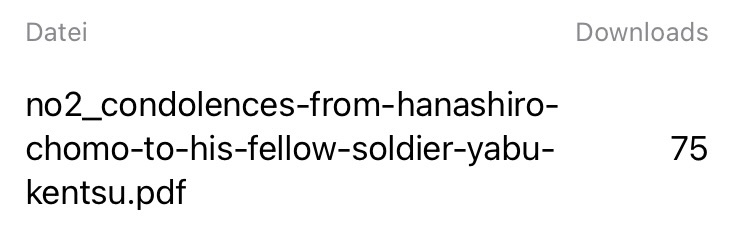
As of today, the article has been downloaded 75 times and was even purchased once afterwards – a very heartfelt gesture that made me truly, truly happy.

How did you like the article?

Did any questions come up?

Were you surprised or even shocked?

And there’s more good news:

Over the next two Fridays, another article about Yabu Kentsu will be published each time – so stay tuned!

Yabu Kentsu Remembered: A Portrait by a Close Companion

I am currently devoting more time again to studying the soldier and karateka Yabu Kentsū. Alongside Higaonna Kanryō, Higaonna Kan’yū, and Go Kenki, he was one of the four teachers of Kyoda Jūhatsu, although it should be noted that Kanryō played the longest role in Kyoda’s training.

In recent years, I have tried to read many of the texts written about Yabu in their original form (Japanese). Of particular note is the work of Yabu’s friend Hanashiro Chōmo. My wife and I once took on the painstaking task of translating Hanashiro’s text as accurately as possible while preserving his writing style. We later succeeded in publishing the text in English as well – until now, however, it was only available for purchase on my Patreon page. I have now decided to make the text freely available, as I consider it very important to provide a complete translation and give subsequent generations of karateka the opportunity to learn more about Yabu.

This obituary – alongside the two-part newspaper article from March 18 and 19, 1932 – is of great importance. The first part has already been translated into English, whereas the article from March 19 has not yet been referenced in any English sources. To better understand Yabu’s mindset and his role as a soldier, both articles are highly recommended. The complete 1932 newspaper article has already been translated and will be published at a later date.

It should also be noted that in the obituary, Hanashiro specifically addresses Yabu’s military service in the First Sino-Japanese War (1894–1895). Hanashiro describes this as an eyewitness, not as someone who merely heard the stories secondhand. Hanashiro’s statements also allow for deeper research regarding the Sino-Japanese War—since he breaks down Yabu’s service from division level down to company level, making it possible to reconstruct the exact course of the war.

Please read, share, and recommend. Anyone interested can still purchase the article on my Patreon page and thereby leave me a small donation.

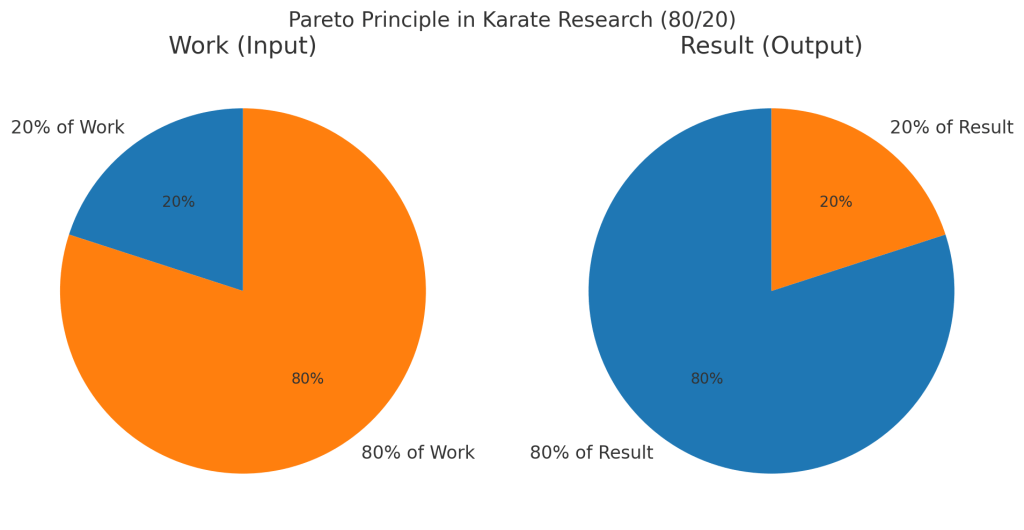
20% Work, 80% Result: The Pareto Principle

Left (Input): 20% of the work vs. 80% of the work.

Right (Output): That small 20% produces 80% of the result, while the other 80% of the work leads to only 20% of the outcome.

Doing 80% of the work for only 20% of the insight can seem very daunting, partly due to limited time and resources… but sometimes all it takes is finding the right key.

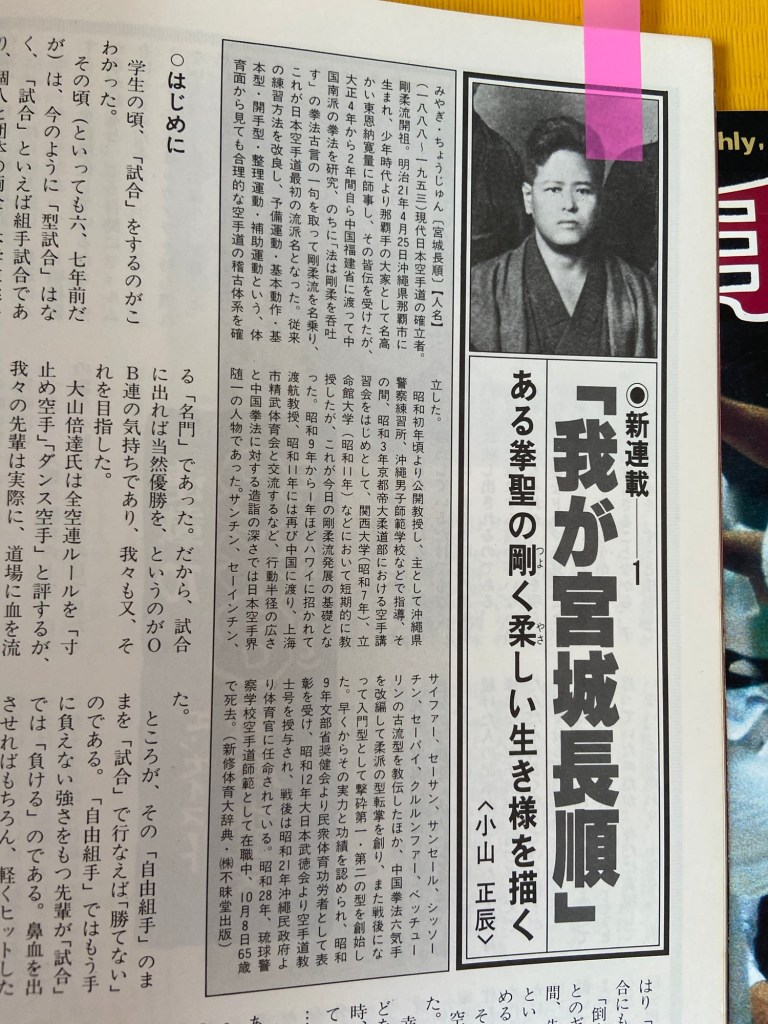
What makes Koyama sensei’s Miyagi Chōjun series so special?

Koyama traveled to Okinawa for a thesis project at Kyoto University—back in 1977—and the focus of his trip was the founder of Gōjū-ryū Karate-dō. As a small side note: around 1977, there were hardly any books or writings on Miyagi or Gōjū-ryū for comparison.

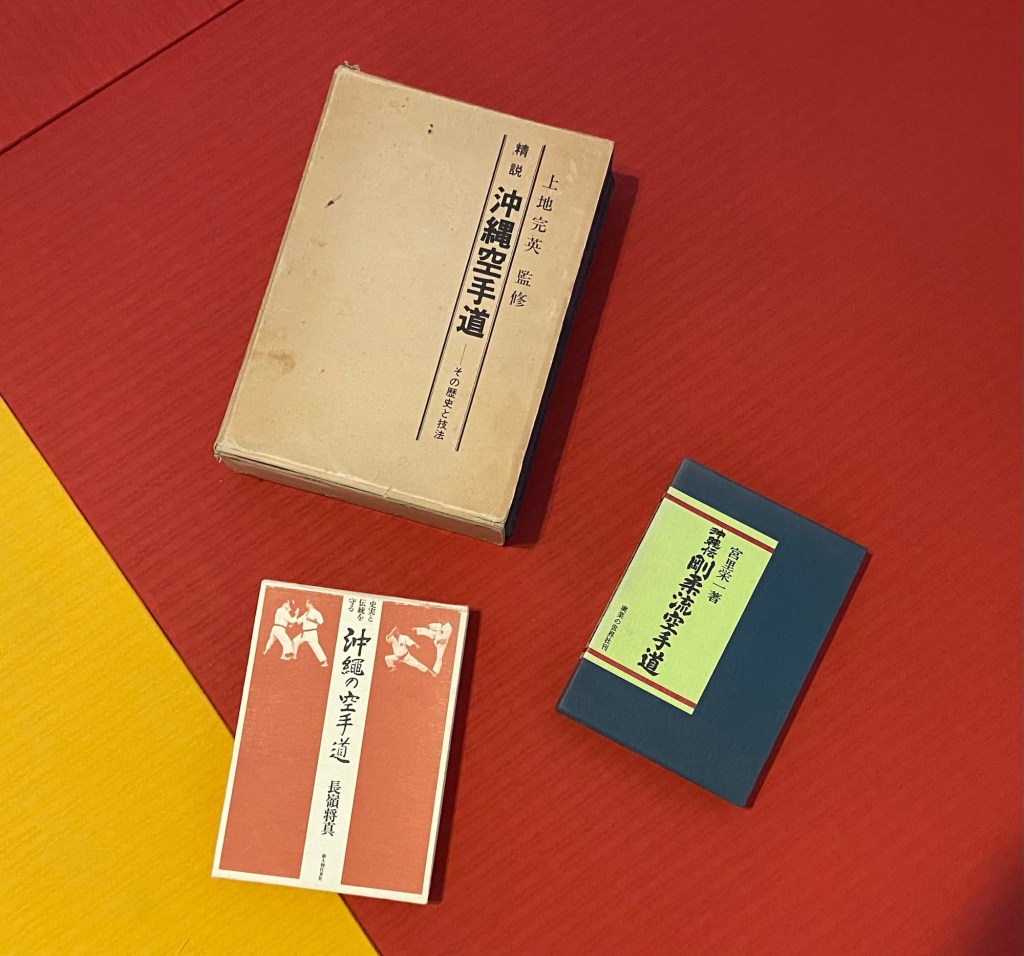
Books by Uechi Kan‘ei (1977), Miyazato Ei‘ichi (1978) and Nagamine Shōshin (1975)

This was one year before Okinawa-den Gōjū-ryū Karate-dō (1978) by Miyazato Ei’ichi sensei was published, two years after the 1975 book by Nagamine Shōshin appeared, and in the same year as the book by Uechi Kan‘ei.

It was, therefore, an early pioneering work in Gōjū-ryū research and on Miyagi Chōjun.

Although Koyama sensei is not an Okinawan, that is actually an advantage—namely, his neutrality. He was able to do something that Okinawans affiliated with a dōjō could not: he could speak with every karateka who had personally known Miyagi—and that is exactly what Koyama did.

He spoke not only with Miyagi’s students, but also with family members, such as Miyagi sensei’s second daughter and fourth son.

The series therefore describes Miyagi’s life in considerable detail. Naturally, research has progressed in the years since; new findings have been made and rare documents discovered that were not available to Koyama at the time. Footnotes will be added for these, carefully adapted and included after consultation.

So there is still more to look forward to.

My Miyagi Chōjun – by Koyama Masashi – First English Translation

Koyama Masashi sensei has been a well-known figure in Gōjū-ryū research in Japan for many years.

My Miyagi Chōjun series

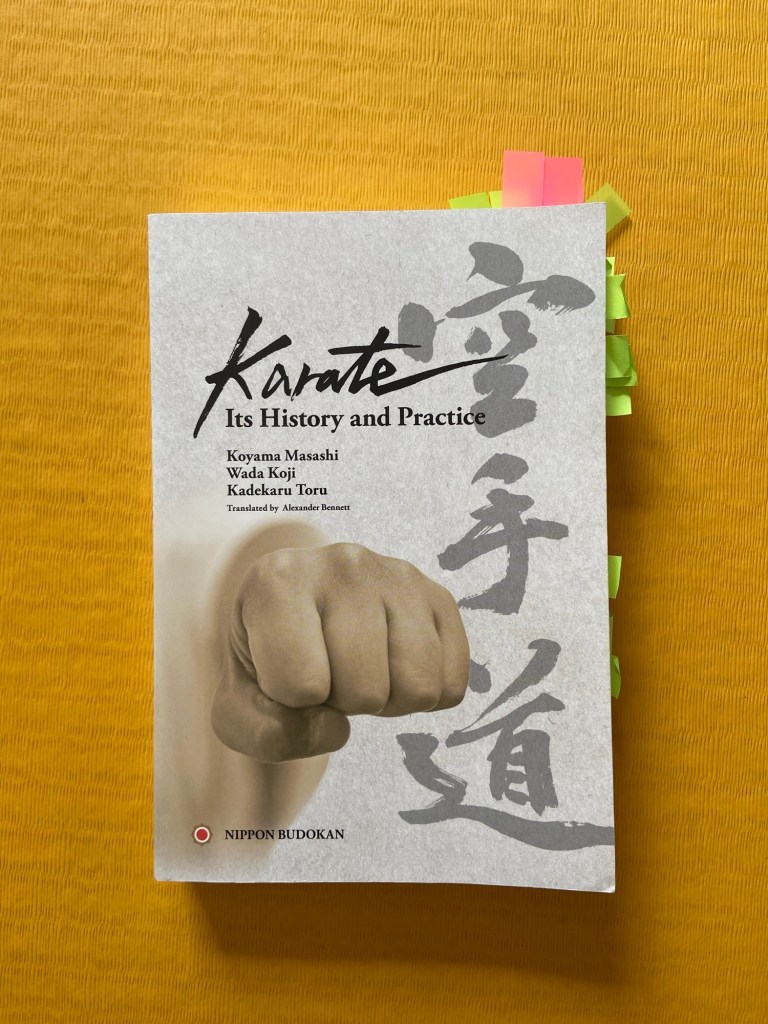
Internationally, he became particularly known through the book Karate – Its History and Practice, which he co-authored with Kadekaru Tōru and Wada Kōji.

Starting as early as 1980, Koyama published a 15-part series about Miyagi Chōjun (plus an additional article about his trip to Shanghai). In addition, many other contributions appeared, including an article about Higaonna Kanryō and an interview with the famous researcher of Chinese martial arts, Matsuda Ryūchi.

Incidentally, he demonstrated the kata Saifā in the famous series Nihon Budō Taikei.

But next to his excellent research, he was also a world champion in kata, and was de-throned by Sakumoto Tsuguo (Ryū‘ei-ryū).

My wife and I are fortunate that Koyama sensei has given us permission to translate his earlier series into English. At first, however, it will be a limited edition. If anyone is interested, please feel free to contact me. The text has been fully typed up and is waiting to be translated—may the translation begin !!!

After much consideration, I would like to publish the book in perfect quality, as a hardcover edition with a ribbon marker and other fine details.

Behind the Scenes: How We Prepare for Our Interviews

I was recently asked how we prepare for our interviews.

A few sources (japanese only)

The answer, of course, is through reading. This means researching sources in advance, examining and translating them, and then formulating questions based on that research. These questions usually arise from points that emerged during the investigation but were not clearly explained in the sources — areas where I seek more detailed information.

Our next interview to be published will be our conversation with Higa Kiyohiko Sensei.

Interview – Headline

In this case, our main focus was on the karate of Hanashiro Chōmo, as well as Yamanni-ryū, which is also preserved at the Bugeikan.

A Helping Hand

It always fills me with joy and satisfaction to support fellow Karateka – even when my help isn’t explicitly acknowledged or met with a simple “thank you.”

I often capture a screenshot before and after offering my small support – and every time, the small difference brings a smile to my face.

Of course, I’d also be happy to receive a small word of thanks – a simple gesture with great meaning. 😉

Shōrin, Shōrin, or Shōrin – but not Shorin

A few days ago, I wrote a short article about the different ways to write Kōdōkan, and I’d now like to draw attention to a similar case – this time concerning Shōrin – which also comes with varying readings.


1. 小林流 – Shōrin-ryū / Kobayashi-ryū

Reading:

  • 小 (shō) → small
    • On-yomi: shō
    • Kun-yomi: chiisai
  • 林 (rin) → forest
    • On-yomi: rin
    • Kun-yomi: hayashi
  • 流 (ryū) → style / school / stream
    • On-yomi: ryū

Meaning: „Style of the small forest“

Origin / Context:
This writing is typical for the Shōrin-ryū style of Okinawan Karate founded by Chibana Chōshin (1885–1969). The kanji were deliberately chosen to evoke a connection to the Chinese Shaolin, but use different characters that are more familiar in Japanese and perhaps stylistically softer. Chibana also wanted to emphasize his own interpretation through this choice.


2. 少林流 – Shōrin-ryū / Sukunaihayashi-ryū

Reading:

  • 少 (shō) → few, young
    • On-yomi: shō
    • Kun-yomi: sukunai, sukoshi
  • 林 (rin) → forest
  • 流 (ryū) → style / school

Meaning: „Style of Shaolin“ (literally: „Style of the young forest“)

Origin / Context:
This is the classical Chinese writing for Shaolin – 少林 (Shàolín in Chinese). In Japanese, it is also read Shōrin. This version appears in more historically or Chinese-oriented contexts, such as when emphasizing the origin from the Shaolin Temple.

In Okinawan Karate, this writing is used in styles that trace back to Kyan Chōtoku, such as Shōrin-ryū Seibukan (Shimabukuro Zenryō) and Shōrinji-ryū (Nakazato Jōen).


3. 松林流 – Shōrin-ryū / Matsubayashi-ryū

Reading:

  • 松 (shō / matsu) → pine (tree)
    • On-yomi: shō
    • Kun-yomi: matsu
  • 林 (rin) → forest
  • 流 (ryū) → style / school

Meaning: „Style of the pine forest“

Origin / Context:
This variant is used in Matsubayashi-ryū, founded by Nagamine Shōshin. „Matsubayashi“ is an alternative reading of the kanji for Shōrin (松林). The name was intentionally chosen as an homage to Matsumora Kōsaku and Matsumura Sōkon, while matsu (pine) is also a symbol of constancy and purity.

Some schools pronounce this writing as Shōrin-ryū, others as Matsubayashi-ryū, depending on how they emphasize their stylistic heritage. In Western literature, both versions are commonly found – for example, Matsubayashi Shōrin-ryū.


An Exception: 書林 – Shorin

This writing appears in an English-language publication where I once mistakenly read it as Shōrin.


書林 – Shorin

Reading (On-yomi):

  • 書 (sho) – book, writing, script
  • 林 (rin) – forest, grove

Meaning:

  • Literally: “Forest of books” or “Grove of writings”
  • Figuratively: publisher, bookshop, place of literature

The term 書林 is also used metaphorically in classical Japanese and Chinese literature to denote:

  • a place of learning
  • a center of literary activity
  • or even a printing house or publishing establishment, particularly during the Edo period (e.g., as a synonym for a book publisher or bookshop)

A well-known bookshop in Okinawa also uses this writing: Gajumaru Shorin / Yōju Shorin (榕樹書林).

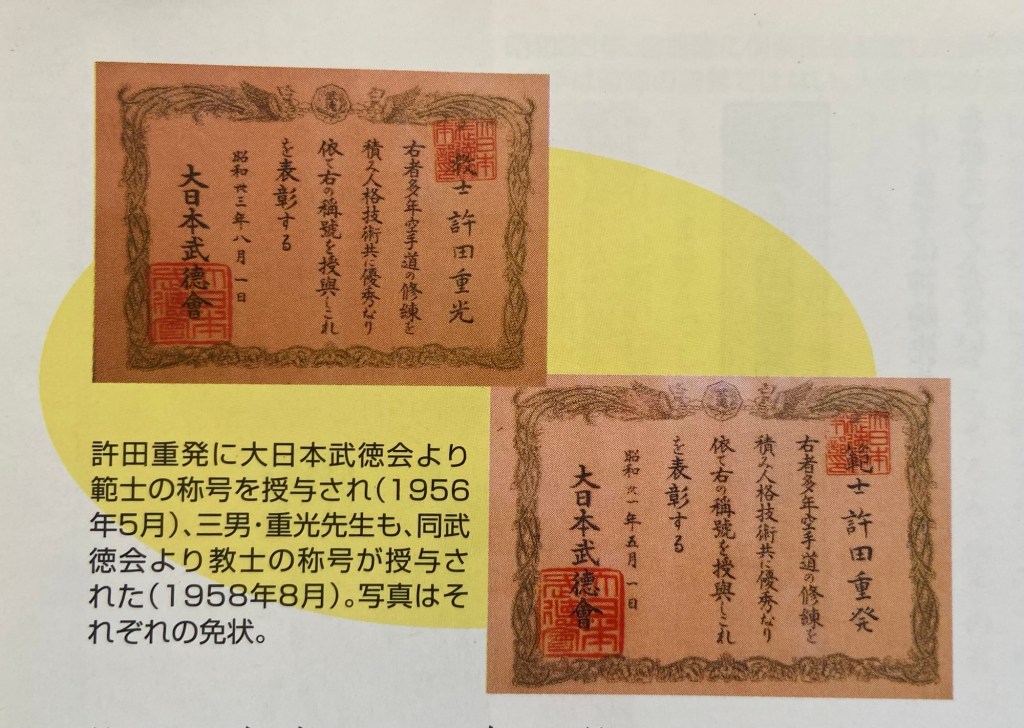
The DNBK Certificate for Kyoda sensei and his son (Jūkō)

Many karateka were already awarded titles by the DNBK before und during the war, including Miyagi Chōjun (Kyōshi) and Mabuni Kenwa (Renshi), among many other masters.

Kyōda sensei and his son, Kyōda Jūkō sensei, on the other hand, were only honored with titles by the newly founded postwar DNBK: Kyōda sensei, who began his training in 1902 under Higaonna Kanryō sensei, was awarded the title of Hanshi after 54 years of training. Two years later, his son Jūkō sensei received the title of Kyōshi.

Translation:

Hanshi – Kyoda Jūhatsu

This person has devoted many years to the practice of Karate-dō and has demonstrated excellence in both character and technique. Therefore, this title is hereby conferred, and this recognition is given.

May 1, Shōwa 31 (1956)

Dai Nippon Butokukai

——————

Kyōshi – Kyoda Jūkō

This person has devoted many years to the practice of Karate-dō and has demonstrated excellence in both character and technique. Therefore, this title is hereby conferred, and this recognition is given.

August 1, Shōwa 33 (1958)

Dai Nippon Butokukai