

It is no secret that I hold a deep and enduring interest in the history of Tōon-ryū. My research in this field is both extensive and ongoing, encompassing a wide range of Japanese articles and English-language publications—even when Tōon-ryū or its history is mentioned only in passing.
In this context, I would like to introduce two books that reference Tōon-ryū. However, I must also highlight some significant inaccuracies within these works. While I greatly appreciate the effort and dedication that both authors have invested in their research, I believe it is important to address these points for the sake of clarity and accuracy.

Thomas Feldmann has undertaken the commendable task of writing a book about Yabu Kentsū, which, in many respects, is well-researched and informative. Within this book, he briefly touches upon the Tōon-ryū tradition.
Interestingly, Shigekazu Kanzaki (1928-2008), the second head of the Tō’on-ryū school of karate, told a similar story, possibly of the same origin as the one portrayed above, which he had heard from his master Jūhatsu Kyoda (1887-1968), who was Yabu’s student at the Okinawa Normal School. (page 96)
However, there are two notable inaccuracies that deserve mention:
1. Date of Passing of Kanzaki Sensei – Feldmann states that Kanzaki Sensei passed away in 2008. However, the correct date is 2018.
2. Lineage of Tōon-ryū – The book omits mention of Kyoda Jūkō (1926–1983), who was the second Sōke (headmaster) of Tōon-ryū. Kanzaki was, in fact, the third Sōke, and the current head of the school is Ikeda Shigehide, the fourth Sōke.
These details are essential in preserving the accuracy of Tōon-ryū’s historical lineage.
Another recent publication discussing Tōon-ryū is Scot Mertz’s book Ryuhoryu. While the book presents valuable insights, there are a few points that I believe warrant clarification.
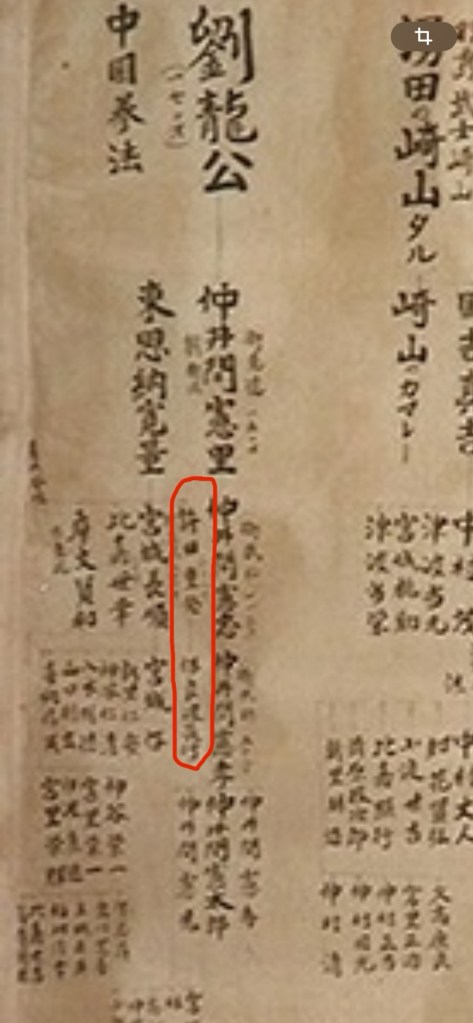
1. Misinterpretation of Calligraphy – On page 64, Mertz reproduces a calligraphy by Nakaima Kenkō. However, he mistakenly confuses the names of Kyoda Jūhatsu and his student, Iraha Chōkō. Instead of correctly identifying Kyoda Sensei, Mertz mistakenly refers to Gusukuma Kōki, another student of Higaonna Kanryō—who, however, does not appear in this particular calligraphy.
2. Diagram of Karate Styles – On page 65, Mertz presents a self-made diagram illustrating various Karate styles. The section concerning Tōon-ryū immediately stood out to me. To help clarify the misunderstandings, I would like to provide the correct names of Kyoda Jūhatsu Sensei’s students, along with the corresponding kanji:
- Iraha Chōkō 伊良波長幸
- Ōnishi Eizō 大西栄三
- Kyoda Jūkō 許田重光
- Kanzaki Jūwa 神崎重和
- Kanzaki Shigekazu 神崎重和
It appears that the confusion may have arisen from a misunderstanding of Japanese kanji readings. The Japanese language employs two primary reading methods: the on-yomi (Sino-Japanese reading) and the kun-yomi (native Japanese reading). It seems that Mertz inadvertently listed Kanzaki Sensei’s name in both reading forms, which could mistakenly give the impression that these were two distinct individuals. I would like to clarify that this is not the case—both readings refer to the same person.
——————
In conclusion, my intention is not to diminish the valuable work of either author but rather to contribute to a more accurate understanding of Tōon-ryū’s rich history. Open and constructive dialogue is essential in maintaining the integrity of martial arts research, and I hope these clarifications serve that purpose.
I deeply respect the dedication required to research and write about these complex subjects and appreciate the efforts both authors have made. It is through such discussions that we can collectively deepen our understanding of these important traditions.
Thank you for your attention and consideration.
 Karate Kenkyū Shitsu