Thank you Ikeda sensei

I would like to express my heartfelt thanks to Ikeda Jūshū 池田重秀, the 4th Sōke of Tō’on-ryū. Without karate training, it is almost impossible to write an academic paper on a karate figure, a karate kata, or even a karate anecdote. In this process, it is not only important to consult written works but also to speak with karateka within a karate lineage. Without taking these steps, the expected research results cannot be achieved.

Tō‘on-ryū Karate-dō – Beppu Honbu [Dōjō] – August 23, 2024

The Jion kata was already my favorite kata during my Shōtōkan days, and I still focus on it. This led to the decision that Ikeda Sensei showed me „Yabu no Jion,“ even though this kata was planned for a later visit. Since I was already familiar with a version of Jion, I was able to quickly adapt Yabus version of Jion – of course, there are still many things that need Ikeda Sensei’s corrections.

I am deeply grateful to Ikeda Sensei for teaching me „Yabu no Jion“ and for allowing us to include two photos with him in the article. A special thanks also goes to my wife, who took the fantastic pictures.

A small note about the photos: we chose identical movements that were also performed by Funakoshi Gichin (1925) and Hanashiro Chōmo (1938).

Ikeda senseis words are as follows:
Yannick, a member of Tō’on-ryū, published his research findings on Jion in [Gekkan] Hiden. I consider the research content to be excellent.
Review – The Origin of the Kata Jion

Wow—Motobu Naoki Sensei has already reviewed my second article. After reviewing my first article on Yabu Kentsū (Gekkan Hiden 7/2024), this time he discussed my article of the Jion Kata.

The review can be found on both Patreon and Medium. Additionally, there is a Japanese review on Motobu Sensei’s Note blog.

Thank you very much for featuring my article and for the kind words—it made me very happy.

Both the Yabu article and the Jion article will be translated into English and will be published next year as part of a book containing many other informative articles.

NEW – Interview Series with Karate Masters from Okinawa

I would like to draw your attention to a small update. I am proud to announce the beginning of our interview series with Okinawan Karate masters.

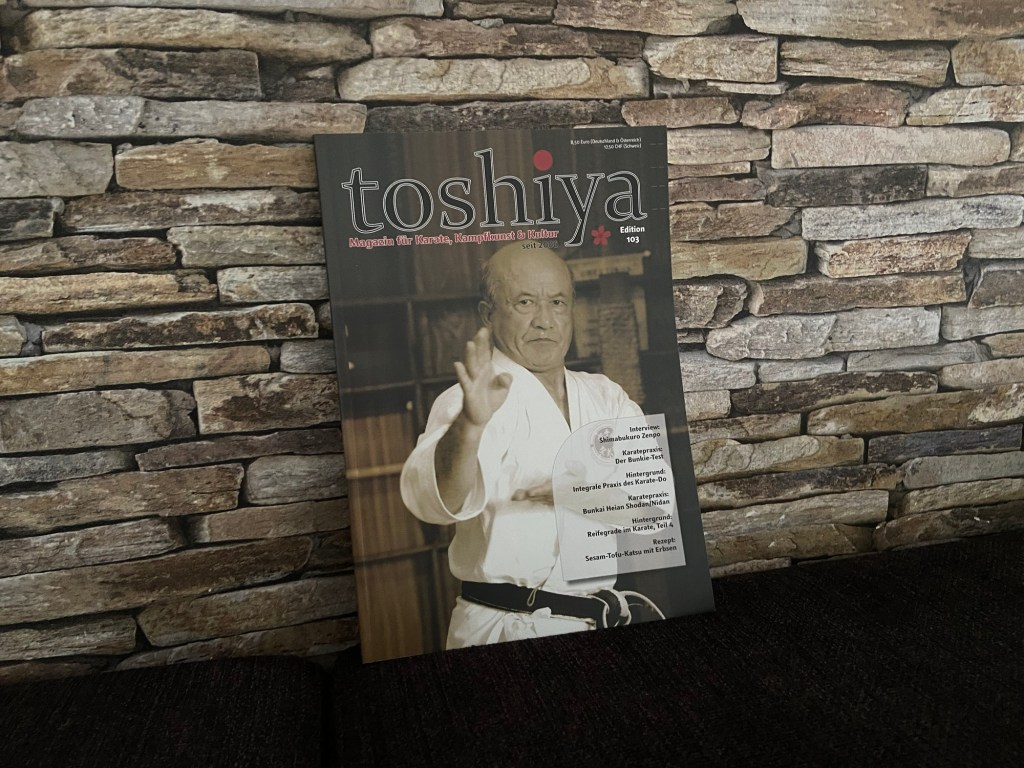
Toshiya, No. 103

In Toshiya Issue No. 103, our very first interview with Shimabukuro Zenpo Sensei (10th Dan Shōrin-ryū Seibukan) has been published. In addition to 40 questions for Shimabukuro Sensei, the interview also includes 10 questions for the German representative of Shōrin-ryū Seibukan, Jamal Measara Sensei (9th Dan Shōrin-ryū Seibukan).

My wife and I conducted these interviews during our last trip to Japan, which was more of a research trip—no, not just three days, but almost the entire journey. During this time, we had the opportunity to conduct several interviews, which will also be published in upcoming issues of Toshiya. They may not appear consecutively, as there will be a rotation, and other interviews with German Karateka, not conducted by us, will also be featured.

So, it might be a good idea to subscribe… there are still many interesting interviews to come.

And if anyone would like to have an interview conducted with their Sensei, feel free to contact us… we will try to make that interview happen as well.

Why do I publish in a Japanese medium?

I was once asked by a German writer why I publish in a Japanese medium, and at the same time, I was told that no one reads it anyway. This was before my first article had even been published (December 2023).

The answer is actually quite simple: for the same reason that I travel to Japan to explore the culture and decipher parts of Karate history in order to preserve them for future generations.

In the meantime, we are about to publish our third article, and the response we have received in Japanese circles has been overwhelming. We also gifted magazines to our interview partners, and the feedback was very positive there as well—the Gekkan Hiden magazine is indeed read in Japan and has been in publication since 1993.

For this reason, we will continue to work intensively with Gekkan Hiden, and we have already submitted two more articles that will be published in mid-October and mid-December. These articles will very likely be read in other countries as well.

How to support a fellow researcher

There are different types of karate historians. There are some who mostly work from home, many who buy their own sources, and then there are those like Andreas Quast, who has spent countless hours, if not days, in archives and various libraries. In this way, he was able to build up a comprehensive, small private archive from which he can still draw today.

Over the years, he has published many books, articles, etc., and is always helpful, leaving behind a clear trail that one can follow to continue working on his research in the future.

We can say THANK YOU or support him by purchasing his books, something I have been doing since 2007.

Or we can follow him on Patreon and support him in his further research projects – which are definitely worth supporting.